Update cookies preferences

Risk Based Inspection Software

Field Eagle gives oil and gas, mining, and industrial operations the tools to implement risk based inspection programs that prioritize assets by failure probability and consequence, enforce inspection schedules based on risk classification, and generate the compliance documentation that API 580, API 581, and other RBI standards require.

Tablet-based and offline-capable for remote and hazardous sites. Supports API 580, API 581, ISO 55000, and risk-based inspection frameworks. Built for oil and gas, mining, petrochemical, and utilities operations.

No obligations, See how it works for yourself.

What Is Risk Based Inspection?

Risk based inspection (RBI) is an approach to inspection planning that prioritizes assets based on their risk level rather than fixed time intervals. It evaluates two factors for every asset: the probability of failure based on age, condition, operating environment, and maintenance history, and the consequence of failure in terms of safety impact, environmental damage, production loss, and regulatory exposure.

By combining probability and consequence, RBI programs assign each asset a risk ranking. High-risk assets receive more frequent, more thorough inspections. Low-risk assets with minimal failure consequences receive less frequent inspections. The result is an inspection program that allocates resources where they have the most impact on safety and operational continuity rather than spreading inspection effort evenly across all assets regardless of actual risk.

In practice, RBI is most widely used in oil and gas, petrochemical, mining, and utilities operations where the consequence of asset failure can be catastrophic. It is the basis of API 580 and API 581 for risk based inspection of pressure equipment, and is referenced in ISO 55000 as a core asset management methodology.

Risk Based Inspection

Traditional inspection programs schedule inspections on fixed calendar intervals regardless of actual asset risk. This approach has two fundamental problems that risk based inspection software is designed to solve.

  • High-risk assets receive the same inspection frequency as low-risk assets, missing the early warning signs that would prevent failures in the assets that matter most
  • Low-risk assets consume inspection resources that could be directed toward higher-consequence equipment
  • Inspection schedules do not update when asset condition changes, meaning a deteriorating asset continues to be inspected on its original schedule regardless of new risk signals
  • Compliance documentation for fixed-interval programs is often manual, inconsistent, and difficult to retrieve during regulatory reviews
  • No systematic way to connect inspection findings to risk level reassignment, so risk classifications become outdated over time

Field Eagle solves all of these problems. The platform connects inspection findings directly to asset risk profiles, enforces inspection schedules based on risk classification, and maintains the complete inspection and risk documentation that RBI standards require.

How Field Eagle Risk Based Inspection Software Works

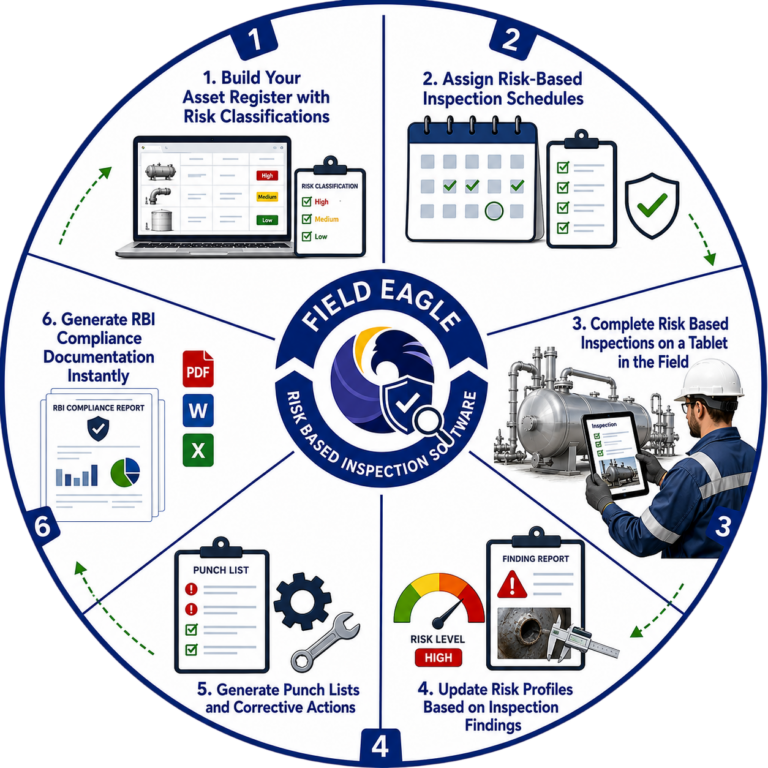
1. Build Your Asset Register with Risk Classifications

Create a comprehensive asset register covering every piece of equipment subject to your RBI program - pressure vessels, pipelines, storage tanks, rotating equipment, structural components, and any other asset where failure consequence is significant. Each asset is assigned a risk classification based on failure probability and consequence assessment. Risk classifications determine inspection frequency, inspection scope, and documentation requirements.

2. Assign Risk-Based Inspection Schedules

Configure inspection intervals for every asset based on its risk classification rather than fixed calendar schedules. High-risk assets are assigned more frequent inspections with more comprehensive checklist requirements. Low-risk assets receive extended intervals. Field Eagle's preventative maintenance scheduling enforces these risk-based intervals automatically, sending alerts when inspections are due and escalating when they become overdue.

6. Generate RBI Compliance Documentation Instantly

Inspection records, risk assessment histories, corrective action logs, and compliance reports generate automatically from Field Eagle data. When API 580, API 581, or regulatory compliance documentation is required, it is retrieved and presented in seconds. No manual compilation. No gaps in the record caused by incomplete documentation.

3. Complete Risk Based Inspections on a Tablet in the Field

Inspectors complete risk based inspections directly on a tablet at the asset location. Field Eagle operates fully offline, making it suitable for offshore platforms, remote pipelines, underground facilities, and any other site without reliable connectivity. Inspection forms capture condition ratings, thickness measurements, corrosion assessments, defect classifications, photo evidence, and inspector signatures. Every finding is linked to the specific asset record and feeds directly into the risk assessment.

5. Generate Punch Lists and Corrective Actions

Every deficiency identified during a risk based inspection generates a corrective action with assigned owner, priority level based on risk classification, and due date. A punch list report is produced for every inspection showing all findings categorized by criticality: critical, major, and minor. The complete corrective action lifecycle is tracked from identification through verified resolution in one system. Reports include full deficiency histories, photos, and risk-based prioritization.

4. Update Risk Profiles Based on Inspection Findings

When an inspection identifies condition changes that affect an asset's risk profile, the risk classification is updated to reflect actual current condition. An asset showing accelerated corrosion moves to a higher-risk classification and receives more frequent inspections. An asset consistently performing within safe parameters may be eligible for extended inspection intervals. Risk classifications are dynamic rather than static, reflecting real asset condition rather than original design assumptions.

Risk Based Inspection Software Features

Risk-Based Asset Register

Organize every asset with risk classifications based on failure probability and consequence. Risk profiles drive inspection frequency, scope, and documentation requirements. Classifications update dynamically based on actual inspection findings.

Risk-Based Inspection Scheduling

Assign inspection intervals based on risk classification rather than fixed calendar schedules. High-risk assets receive more frequent inspections. Low-risk assets receive extended intervals. Schedules enforced automatically with overdue escalation.

Asset Condition History

Every inspection adds to the asset's condition history. Track corrosion rates, degradation patterns, and condition trends over time. Historical data informs risk profile updates and supports RBI methodology requirements.

Multi-Site Risk Management

Manage risk based inspection programs across multiple facilities and sites from one centralized platform. Compare risk profiles and inspection performance between locations. Standardize RBI processes across the entire operation.

Offline Tablet Inspections

Complete risk based inspections on a tablet at any asset location without internet connectivity. Full offline functionality including condition rating capture, photo documentation, and digital signatures. Automatic sync when connectivity returns.

Punch List and Corrective Action Management

Every inspection produces a punch list categorizing findings by criticality. Corrective actions created automatically with risk-based priority ranking. Complete lifecycle tracking from identification through verified resolution.

RBI Compliance Documentation

API 580, API 581, and regulatory compliance documentation generated automatically. Complete inspection histories, risk assessment records, and corrective action logs retrievable instantly for regulatory reviews or insurance audits.

Customizable Inspection Forms

Build RBI inspection forms configured for each asset class - pressure vessels, pipelines, storage tanks, rotating equipment. Condition rating scales, measurement fields, corrosion assessment categories, and photo requirements all configurable.

Risk Based Inspection Software by Industry

risk based inspection

Oil and Gas Risk Based Inspections

Pressure vessel RBI programs under API 580 and API 581, pipeline integrity management, storage tank inspections under API 653, rotating equipment condition monitoring, and process safety management documentation. Field Eagle supports the full range of oil and gas inspection requirements with offline capability for offshore platforms and remote onshore sites.

using data to improve mining operations

Mining Risk Based Inspections

Structural integrity assessments for tailings storage facilities, underground ground support condition monitoring, processing equipment risk prioritization, conveyor and crushing system inspections, and MSHA compliance documentation. Field Eagle’s mining inspection software runs fully offline underground and at remote surface sites.

Petrochemical and Refinery Inspections

Petrochemical and Refinery Inspections

Process vessel inspections, heat exchanger condition assessments, piping system integrity checks, fired heater inspections, cooling tower RBI programs, and environmental compliance documentation. Field Eagle supports complex hierarchical inspection structures suitable for refinery and petrochemical facility asset management.

Electrical Utilities Safety Compliance Checklist

Utilities Risk Based Inspections

Transmission and distribution infrastructure risk prioritization, substation equipment condition assessments, pipeline corrosion monitoring, and regulatory compliance documentation. Field Eagle’s utilities inspection software manages RBI programs across large and geographically dispersed infrastructure networks.

Showing Slide 1 of 4

Field Eagle risk based inspection software is designed to meet the documentation and process requirements of the RBI standards and frameworks most relevant to industrial operations. All compliance documentation is maintained automatically:

  • API 580 Risk Based Inspection methodology for fixed equipment in the oil and petrochemical industries
  • API 581 Risk Based Inspection Technology providing quantitative risk assessment procedures
  • API 653 Above Ground Storage Tank Inspection, Repair, Alteration, and Reconstruction
  • API 570 Piping Inspection Code for in-service inspection of piping systems
  • ISO 55000 Asset management system requirements including risk-based inspection planning
  • ASME pressure vessel and piping inspection standards
  • MSHA equipment and infrastructure inspection requirements for mining operations
  • OSHA Process Safety Management Standard 29 CFR 1910.119

What Our Clients Say About Us

Frequently Asked Questions

Risk based inspection software is a digital platform that implements RBI methodology by connecting asset risk classifications to inspection schedules, field inspection execution, condition data capture, and compliance documentation in one system. Field Eagle is risk based inspection software that runs on tablets, operates offline at remote and hazardous sites, and maintains the complete inspection and risk documentation that API 580, API 581, and other RBI standards require.

Fixed-interval inspection schedules every asset at the same frequency regardless of its actual risk level. Risk based inspection assigns inspection frequency based on each asset’s failure probability and the consequence of that failure. High-risk assets are inspected more frequently and thoroughly. Low-risk assets receive extended intervals. The result is better protection for the assets that matter most while reducing unnecessary inspection effort on assets where the risk is low.

API 580 establishes the minimum general principles and methodology for implementing a risk based inspection program for fixed equipment in the oil and petrochemical industries. It is a qualitative to semi-quantitative framework covering how to assess and manage risk. API 581 is the complementary quantitative document that provides the specific risk based inspection technology, calculation procedures, and consequence modeling methodologies referenced by API 580. Most oil and gas operations use both standards together when implementing a formal RBI program.

Yes. Field Eagle manages unlimited assets organized in unlimited hierarchies. Every asset carries a risk classification that drives its inspection schedule, inspection scope, and documentation requirements. Risk classifications update based on actual inspection findings rather than remaining static from the original assessment. Managers can view risk profiles across the entire asset fleet from the central dashboard, identifying which assets have elevated risk and which are scheduled for upcoming inspections.

Yes. Field Eagle runs on tablets and operates fully offline. Risk based inspection teams can complete full inspections including condition ratings, corrosion measurements, defect classifications, photo capture, and digital signatures at offshore platforms, remote pipelines, underground facilities, and any other site without reliable connectivity. All data syncs automatically to the central database and asset risk records when connectivity is restored.


Field Eagle prioritizes corrective actions based on the risk classification of the asset and the severity of the finding. Critical findings on high-risk assets trigger immediate alerts and receive the highest priority in the corrective action queue. Minor findings on low-risk assets are documented and scheduled for resolution within standard timeframes. Every corrective action is tracked from identification through verified resolution with full traceability back to the original inspection finding and asset risk record.

Request a Free Demo

Call Us

Call or Fill out the Form

or Fill out the Form

Request a Demo


Request a Feature

Request a Feature

Contact Us


We take your privacy seriously and will never share your information.

Contact Us


We take your privacy seriously and will never share your information.

Request a Demo


We take your privacy seriously and will never share your information.

Podcast