Heavy equipment failures are expensive. A haul truck breakdown at a mining operation can halt production for an entire shift. A crane failure on a construction site can shut down a project and trigger regulatory investigation. An excavator breakdown during critical earthworks creates schedule delays with contractual consequences.
Most of these failures are preventable. Not by spending more on maintenance, but by running a more effective heavy equipment inspection program that catches problems before they cause breakdowns. Here are five signs your current inspection program is not doing that.
Sign 1: You Are Finding Out About Equipment Problems When They Break Down
This is the most obvious sign and the most important one. If your maintenance team spends most of its time responding to equipment failures rather than preventing them, your inspection program is not catching defects early enough.
Equipment failures in heavy machinery almost never happen without warning. Bearings show increased temperature and vibration before they fail. Hydraulic systems develop small leaks before catastrophic hose failures. Structural components show cracks before they reach critical size. These are detectable during inspection if inspection checklists cover the right items and condition data is reviewed across inspection cycles.
If your team is constantly surprised by failures, ask whether your inspection checklists cover the early warning indicators for your most critical failure modes, and whether anyone is reviewing condition trends across inspection history to detect gradual deterioration before it becomes acute.
Sign 2: Pre-Shift Inspections Are Being Rushed or Skipped
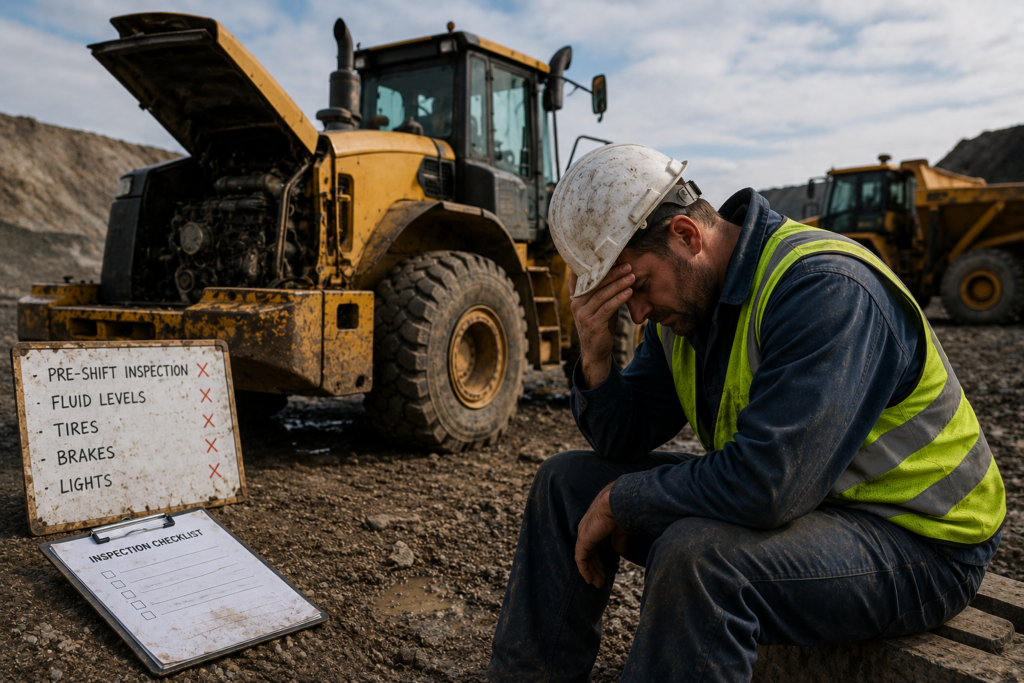
Pre-shift inspections are the foundation of any heavy equipment inspection program. They catch defects that developed since the previous shift, verify safety systems are functional before operation, and document the condition of equipment at the start of each production period.
When operators rush pre-shift inspections, they may check items without examining them. If they skip inspections entirely, equipment failure may provide the first warning of a problem.
Common reasons pre-shift inspections deteriorate:
- Paper checklists with no enforcement mechanism allow items to be skipped
- Operators under production pressure cut inspection time to get started faster
- No visibility for supervisors into whether inspections are being completed fully
- Inspections that generate findings create administrative work that operators want to avoid
Digital inspection platforms with required fields, photo documentation requirements, and supervisor visibility through real-time dashboards address all four of these issues. Digital inspection checklists cannot be submitted with required items skipped, giving supervisors confidence that inspections are completed properly.
Sign 3: Equipment Condition Data Is Not Being Trended
Individual inspection reports show the condition of equipment at a specific point in time. Trending condition data across inspection cycles shows whether that condition is improving or deteriorating, and at what rate. This trend data is what predicts failures before they happen.
If your inspection program generates reports but does not systematically trend condition data across inspection cycles, you are missing the most valuable output your inspection program can produce.
The challenge is that manual trending of condition data across large fleets is not practical. Asset management software that automatically builds condition histories for every asset in the fleet and surfaces deterioration trends makes this analysis practical at scale without requiring manual data compilation.
Sign 4: Corrective Actions From Inspections Are Not Being Tracked
Finding a defect is only half the work; teams must also resolve it. Therefore, inspection programs need a formal process that tracks each finding through verified closure. Otherwise, the same defects will recur across inspections.
This is a corrective action tracking problem. It is also a risk accumulation problem. Every unresolved finding represents a defect that is getting worse while it waits for attention.
Effective heavy equipment inspection programs generate corrective actions automatically from inspection findings, assign them to specific owners with due dates, and track their resolution status. Managers see all open corrective actions across the fleet, not just the ones that got shouted about loudest.
Sign 5: You Cannot Tell Which Equipment Is Highest Risk Right Now
At any time, equipment conditions vary across the fleet. For example, some assets deteriorate faster, carry significant corrective-action backlogs, or approach thresholds that require major intervention.
Can you identify right now which five pieces of equipment in your fleet pose the greatest risk of failure? If that question requires pulling reports, compiling data, and making subjective judgments about relative risk, your inspection program is not giving you the visibility you need.
A well-functioning heavy equipment inspection program should be able to answer that question from a dashboard in seconds. AI Preventative Maintenance takes this further by analysing inspection history to identify which equipment is showing failure patterns based on historical data, not just current condition ratings.
What an Effective Heavy Equipment Inspection Program Looks Like
An effective heavy-equipment inspection program has five characteristics:
- Standardized digital checklists that cover early warning signs of critical failures
- Controls that ensure teams complete pre-shift and periodic inspections
- Condition data that automatically updates asset histories and trends
- Corrective-action tracking from identification through verified resolution
- Finally, dashboards that identify the highest-risk equipment without manual reporting
Field Eagle’s heavy equipment inspection software provides all five.Teams complete inspections on tablets with mandatory fields. Meanwhile, condition data updates asset histories automatically, and corrective actions remain visible through closure. Finally, real-time dashboards show equipment condition, inspection status, and action backlogs across the fleet.
Frequently Asked Questions
Operators conduct pre-shift inspections on heavy equipment used daily. In addition, teams perform detailed checks weekly, monthly, or at service intervals based on operating hours. However, equipment type, manufacturer guidance, and OSHA or MSHA requirements determine the final schedule.
Typically, a heavy-equipment pre-shift inspection covers overall condition, leaks, structural damage, fluid levels, tires or tracks, brakes, steering, safety devices, cab controls, visibility, operator restraints, and known defects that require continued monitoring.
When an inspection identifies a defect, the inspector should document it with photographs, a description, and a severity rating. Safety-critical defects require immediate removal from service. Meanwhile, less critical defects should generate corrective actions with owners and due dates. Finally, teams should track every finding through verified resolution.
Digital checklists prevent incomplete submissions by requiring every field and key photograph. Moreover, real-time dashboards help supervisors identify unrealistically fast inspections. Finally, item-level timestamps reveal suspicious completion patterns.
Equipment failures rarely occur without warning. Instead, inspection data often reveals gradual deterioration across several cycles. For example, rising bearing temperatures, declining hydraulic pressure, or expanding cracks can indicate developing failure. Therefore, teams must analyse inspection history rather than review each report separately.
Yes. AI analyses historical inspection data to identify deterioration patterns that preceded earlier failures. Therefore, it can flag at-risk assets and recommend action before conditions become critical. Moreover, this approach can outperform simple threshold alerts by evaluating how several condition indicators combine and change over time.