Underground mining environments are completely dependent on controlled airflow to maintain safe working conditions. Unlike surface operations, there is no natural air exchange, so even small disruptions in ventilation can quickly change atmospheric conditions across active work areas.
Because gases can accumulate or displace oxygen without visible warning, ventilation performance must be continuously verified as part of normal operations rather than treated as a periodic check. The stability of the entire working environment depends on how consistently airflow and atmospheric conditions are monitored and maintained.
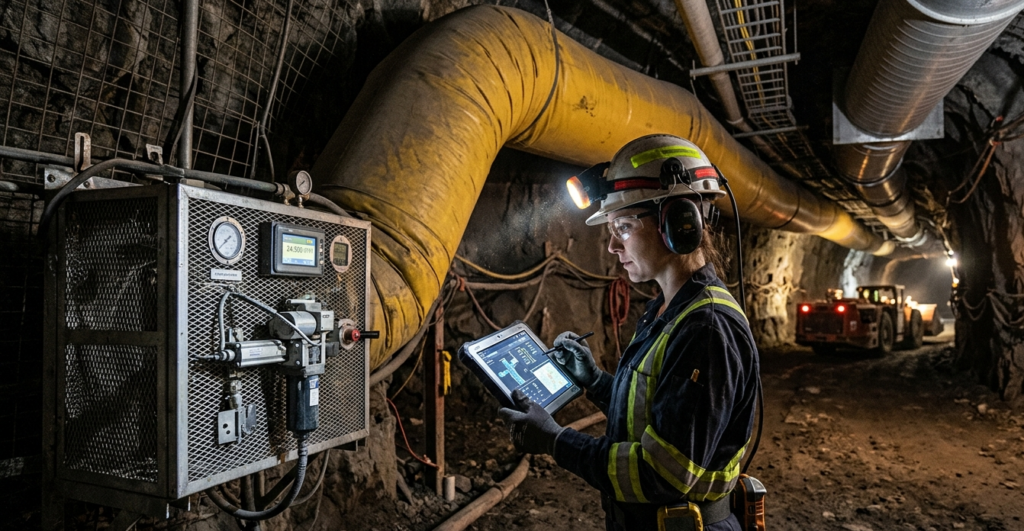
The following guide explains how underground ventilation systems are inspected in practice, including how airflow, equipment performance, and atmospheric conditions are evaluated across different operational intervals.
Why Underground Ventilation Is a Life Safety System
Underground mining produces methane from coal seams and other geologic formations. Without continuous ventilation, methane accumulates to explosive concentrations. The Mine Safety and Health Administration classifies ventilation systems as primary life safety systems with zero-defect tolerance. Ventilation failures cause two types of fatalities: explosions when methane reaches the 5 to 15 percent explosive range, and asphyxiation when oxygen falls below safe levels due to displacement or consumption.
MSHA Part 57 mandates continuous ventilation during all mining operations. The main fan must operate continuously. Air flow must be monitored daily. Methane must be tested at least every 8 hours in areas where accumulation is possible. These are minimums. Most operations that prioritize safety test more frequently.
Atmospheric Safety Thresholds
Methane Levels
- Below 0.5%: Safe for normal operations
- 0.5% to 1.0%: Elevated. Stop work, increase ventilation, investigate source
- Above 1.0%: Dangerous. Immediate evacuation required. Do not re-enter until ventilation is restored and atmosphere retested
- 5% to 15%: Explosive range. Any ignition source causes explosion
Oxygen Levels
- 19.5% to 23.5%: Safe range for normal operations
- Below 19.5%: Oxygen deficient. Evacuate and increase ventilation
- Above 23.5%: Oxygen enriched. Fire and explosion hazard. Increase ventilation
Carbon Dioxide Levels
- Below 0.5%: Acceptable for normal operations
- 0.5% to 1.5%: Elevated. Increase ventilation, investigate source
- Above 1.5%: Evacuate. Identify and eliminate source before re-entry
Complete Ventilation System Inspection Checklist
Daily Main Fan Inspection
- Main fan operating at specified speed and volume
- No unusual vibration detectable at fan housing
- No unusual noise from fan or motor
- Pressure gauge reading within normal operating range
- No visible damage to fan housing, inlet, or discharge
- Fan intake clear of debris and obstructions
- Motor temperature within normal operating range
- All safety guards in place and secure
- Daily operation documented with time and readings
Daily Air Flow Verification
- Air flow measured at all designated monitoring points
- Flow rates meet minimum requirements per approved ventilation plan
- Return air routes free of obstruction or blockage
- All brattice and stoppings intact and sealing properly
- No air bypassing around ventilation controls
- Readings documented and compared to previous day
Atmospheric Testing (Every 8 Hours Minimum)
- Methane detected at all working face locations before entry
- Methane readings recorded: must be below 0.5%
- Oxygen levels recorded: must be 19.5% to 23.5%
- Carbon dioxide levels recorded: must be below 0.5%
- Testing equipment calibrated within past 24 hours
- All results documented with time, location, and tester identification
Weekly Fan and Drive System Inspection
- Fan bearing temperatures within normal range
- Lubricant levels adequate and not contaminated
- Drive belts or couplings in good condition without slippage
- All fasteners secure on fan mounting and structure
- No fluid leaks from hydraulic systems if applicable
- All electrical connections secure and not corroded
Monthly Ventilation Integrity Assessment
- All brattice curtains intact and sealing properly
- All ventilation stoppings structurally sound and sealed
- No air leakage past seals exceeding acceptable limits
- Overcasts and undercasts functioning correctly
- Air splitting (bypass) minimized and within plan tolerances
- Dust suppression systems operational at all working faces
Quarterly Ventilation Plan Review
- Current air flow verified against approved ventilation plan
- Plan compared against current mining layout for accuracy
- Assessment of ventilation adequacy for all working areas
- Identification of any areas requiring ventilation improvement
- Documentation of any plan updates required
- Updated plan submitted to MSHA if changes are made
Emergency Response Procedures
Methane Exceeding 1.0%
Immediately stop all work and remove all personnel from the affected area. Do not re-enter under any circumstances. Isolate the area by closing ventilation controls if possible without risk to personnel. Contact mine management and MSHA immediately. Do not restore ventilation flow until trained personnel have assessed the source. Do not re-enter until three consecutive atmospheric tests over 30 minutes show methane below 0.5%.
Oxygen Deficiency Below 19.5%
Evacuate immediately without hesitation. Oxygen deficiency can cause rapid incapacitation without warning. Do not send anyone back to retrieve equipment. Contact mine management and MSHA. Determine cause of oxygen displacement before re-entry. Restore ventilation and test to confirm safe atmosphere before any personnel re-enter.
Digital Ventilation Inspection Management
Field Eagle’s mining inspection software integrates with atmospheric monitoring programs to create automatic compliance documentation, real-time alerts for out-of-range readings, and complete ventilation inspection history that satisfies MSHA documentation requirements.
Automatic alerts are sent to supervisors the moment any atmospheric reading exceeds threshold values. Therefore, there is no waiting for the next shift report. Moreover, teams do not need to rely on inspectors to remember to call in high readings. As a result, the system provides instant notification and creates a timestamped record of every alert and every response action taken.
Frequently Asked Questions
MSHA Part 57 requires methane detection at least every 8 hours in areas where accumulation is likely. Many operations test more frequently. Continuous monitoring systems are increasingly common in high-risk seams.
Methane becomes explosive when mixed with oxygen in the 5 to 15 percent range. Action is required at 0.5 percent and evacuation at 1.0 percent, providing a significant safety margin before reaching explosive concentrations.
Automated continuous monitoring is available and increasingly common. However, manual testing must continue as backup verification and to calibrate automated systems. MSHA requires documented manual testing regardless of automated system status.
Stop all mining operations in the affected area. Attempt to increase fan speed if possible. Identify the cause of reduced air flow: blocked brattice, fan mechanical issue, or ventilation circuit problem. Restore adequate air flow. Retest atmosphere before resuming operations.
Emergency ventilation repair: $50,000 to $500,000 depending on damage extent. Methane explosion or asphyxiation fatality: immeasurable human cost plus regulatory shutdown, legal liability, and potential criminal charges.
Related Field Eagle Solutions
- Mining Inspection Software: fieldeagle.com/mining-inspection-software/
- Health and Safety Inspection Software: fieldeagle.com/health-safety-inspection-software/
- Inspection Management Software: fieldeagle.com/inspection-management-with-field-eagle/
- Standards Compliance Software: fieldeagle.com/standards-compliance/