CNC machines are among the most critical assets in modern manufacturing, and also among the most expensive to repair when they fail unexpectedly. Even short periods of downtime can disrupt production schedules, delay customer orders, and create costly downstream bottlenecks. Most CNC failures do not happen suddenly; they build up over time through small issues like bearing wear, coolant degradation, and missed maintenance tasks. This guide outlines a structured preventative maintenance and inspection scheduling approach that helps manufacturers reduce unplanned downtime, extend machine life, and maintain consistent production quality.
The Cost of Unplanned CNC Downtime
CNC machines form the core of modern manufacturing. Therefore, a single unplanned breakdown can stop the machine, disrupt dependent processes, and sometimes halt the entire production line. As a result, costs can rise quickly.
Direct cost of unplanned CNC failure:
- Lost production: $500 to $1,000 per hour at standard production rates
- Emergency repair labor: 150 to 200 percent of standard rates
- Expedited parts shipping: 3 to 10 times standard parts cost
- Secondary damage if failure is catastrophic: $50,000 to $200,000
Indirect costs that are rarely calculated but always real:
- Customer order delays and potential late delivery penalties
- Production rescheduling costs across affected product lines
- Overtime labor to recover lost production
- Quality issues on first parts after restart from cold machine
The Association for Manufacturing Technology reports that unplanned downtime costs US manufacturers more than $50 billion annually. CNC machine failures are among the leading contributors. A preventative maintenance program that reduces unplanned downtime by 50 percent generates immediate, measurable return.
CNC Machine Preventative Maintenance Schedule
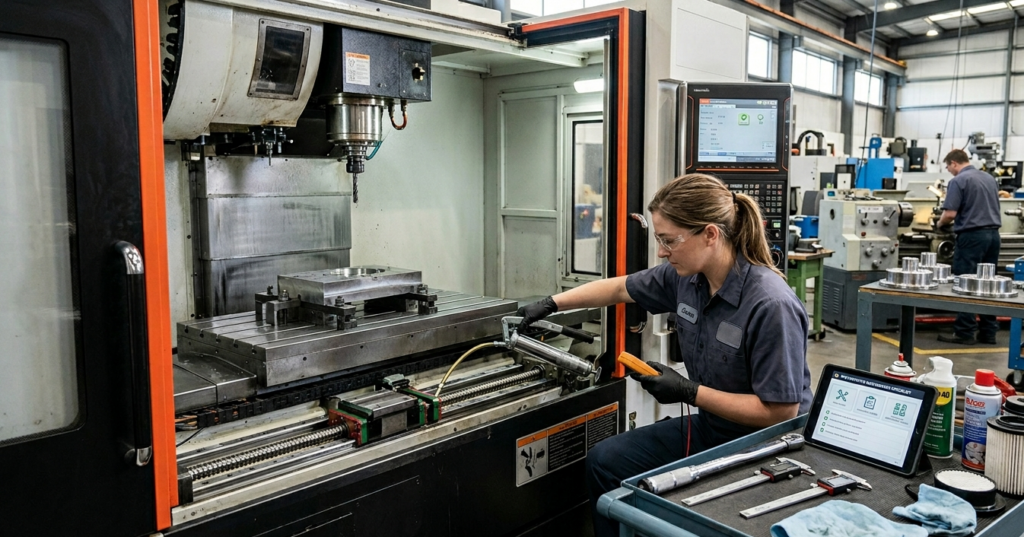
Daily Inspection (5 to 10 Minutes Before First Part)
- Spindle bearing temperature: measure with infrared thermometer, normal range 40 to 50 degrees Celsius
- Coolant level: verify reservoir at proper level, no discoloration or odor
- No unusual sounds during spindle warm-up at low speed
- No unusual vibration detectable by hand on machine body
- Tool changer cycles smoothly through full sequence
- Hydraulic pressure at correct operating value
- No visible fluid leaks under or behind machine
- Chip conveyor operating and not jammed
- Door interlocks and safety systems functional
Weekly Inspection (30 Minutes)
- Verify axis zero return accuracy against known reference part
- Check tool length offset repeatability with test bar
- Inspect coolant filter: clean or replace if restricted
- Check all axis drive belts for tension and wear
- Verify all guarding panels in place and latched
- Inspect air filter and regulator: drain moisture, verify pressure
- Check coolant concentration with refractometer: maintain specified range
- Lubrication system: verify cycle is operating, check reservoir level
Monthly Inspection (1 to 2 Hours)
- Spindle bearing noise assessment: run at multiple speeds, listen for roughness
- Guide rail inspection: check for corrosion, scoring, or uneven wear
- Linear bearing inspection: check for binding or play
- Belt tension measurement with tension gauge on all drive systems
- Hydraulic fluid condition: check color, clarity, and level
- Electrical cabinet inspection: check connections, look for heat marks
- Lubrication system function test: verify all lube points receiving lubrication
- Coolant system: check for bacterial growth, test concentration, inspect nozzles
Quarterly Inspection (2 to 4 Hours)
- Dimensional accuracy testing: machine a known geometry, measure against specification
- Spindle vibration measurement with accelerometer at all speeds
- Thermal imaging of all bearings, motors, and drive components
- Gearbox condition assessment: noise, vibration, temperature
- Control system diagnostics: run full self-test sequence
- Planned replacement of service life components: belts, filters, seals as scheduled
- Way cover inspection: look for damage, verify smooth movement
Annual Overhaul
- Complete machine calibration by qualified service technician
- Spindle bearing assessment: replace if hours or condition indicate
- Full oil change: spindle, gearbox, hydraulic
- Coolant system complete flush and recharge
- All belt replacement regardless of apparent condition
- Seal inspection and replacement on all axes
- Control software backup and update
- Laser or ball bar accuracy calibration and correction
Spindle Bearing Condition Monitoring
Spindle bearings are the highest-value component in a CNC machine and the most expensive to repair when they fail catastrophically. A failed spindle bearing often damages the spindle housing, requiring complete spindle rebuild or replacement at $20,000 to $100,000.
Temperature Trending
After 30 minutes at operating speed, measure the spindle-bearing housing daily with an infrared thermometer. Typically, temperatures should remain between 40°C and 50°C. However, 60°C indicates a warning, while 75°C indicates replacement. Finally, record each reading in the digital maintenance log. Temperature trending over 3 to 6 months reveals bearing degradation 4 to 8 weeks before catastrophic failure.
Vibration Analysis
Vibration analysis detects bearing degradation that temperature checks may miss. Therefore, technicians should establish a baseline for new or recently serviced spindles and repeat measurements quarterly. Moreover, frequency analysis can identify inner-race, outer-race, rolling-element, and cage defects by their characteristic signatures.
Acoustic Monitoring
Daily listening during spindle warm-up is the simplest and most immediate bearing condition indicator. Rough running, grinding, or high-pitched noise indicates bearing degradation. Train operators to identify abnormal spindle sounds. Operator reporting is the first layer of bearing condition monitoring.
CNC Coolant System Maintenance
Coolant system neglect is a leading cause of tool life degradation, surface finish problems, and spindle bearing failures from contaminated coolant infiltration. Monthly coolant management prevents these problems.
- Test coolant concentration weekly with refractometer: maintain manufacturer recommended range
- Test pH monthly: below 7.5 indicates bacterial growth requiring biocide treatment or coolant change
- Inspect coolant color: brown or dark coolant indicates high tramp oil contamination or bacterial growth
- Smell coolant: rancid odor indicates bacterial growth regardless of concentration
- Change coolant completely when pH drops below 7.5 or odor develops
- Clean tank completely at each coolant change: remove chips, sludge, tramp oil
Digital CNC Maintenance Management
Field Eagle’s manufacturing inspection software automates CNC maintenance scheduling. Daily inspection reminders go to operators before first shift. Weekly and monthly inspections are automatically assigned to maintenance technicians. Overdue inspections escalate to supervisors.
The preventative maintenance platform maintains complete spindle temperature history for every machine. Temperature trend alerts fire automatically when readings exceed your defined thresholds. Bearing replacement is planned, not emergency.
Field Eagle’s asset management software tracks hours on spindles and calculates remaining service life based on your temperature and vibration trend data. Equipment replacement is budgeted accurately, not discovered in crisis.
Frequently Asked Questions
Typical spindle bearing life is 5,000 to 10,000 operating hours under normal conditions. Inspect at 3,000 hours using vibration and temperature analysis. Replace at 5,000 hours or when temperature or vibration trending indicates degradation regardless of hours.
Planned bearing replacement: $500 to $2,000 in parts plus 4 to 8 hours labor. Catastrophic bearing failure: $20,000 to $100,000 in spindle rebuild or replacement plus 1 to 3 weeks downtime plus potential machine damage.
pH below 7.5, rancid odor, brown or dark color, or concentration outside manufacturer range all indicate coolant replacement is required. Test weekly. Change when any indicator exceeds threshold.
Yes significantly. Maintaining clean coolant prevents coolant infiltration of bearings. Proper warm-up procedures reduce thermal shock. Avoiding over-speed or overload conditions extends bearing life. Proper lubrication at all intervals maintains oil film.
Annual overhaul by a qualified service technician typically takes 1 to 3 days depending on machine size and condition. Schedule during planned production downtime. The investment prevents 5 to 10 days of unplanned downtime over the following year.
Related Field Eagle Solutions
- Manufacturing Inspection Software: fieldeagle.com/manufacturing-inspection-software/
- Preventative Maintenance Software: fieldeagle.com/preventative-maintenance-made-easy-with-field-eagle/
- Asset Management Software: fieldeagle.com/asset-management-software/
- Asset Maintenance Software: fieldeagle.com/asset-maintenance-software/