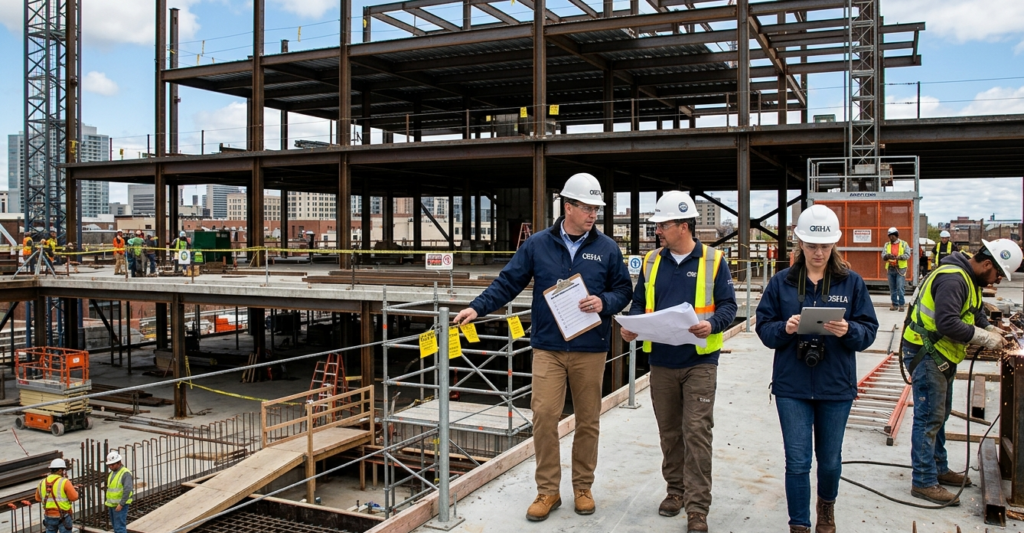
OSHA construction site compliance depends on what happens every day in the field. Because conditions change constantly as work progresses, equipment moves, and new hazards emerge, daily inspections remain a core requirement under CFR 1926. Moreover, when teams conduct these inspections inconsistently or document them poorly, even small oversights can cause serious safety incidents and costly citations. Therefore, this guide provides a complete daily OSHA construction inspection checklist and explains the key requirements and violation risks that site managers must control to maintain a safe and compliant work environment.
OSHA Construction Safety Requirements
CFR 1926 is OSHA’s comprehensive construction safety standard. The Occupational Safety and Health Administration issues more than 30,000 construction site citations annually. The top ten most cited standards in construction account for the majority of all citations. Understanding these categories is the foundation of an effective daily inspection program.
Key CFR 1926 standards every construction site manager must know:
- 1926.501: Duty to have fall protection (most frequently cited standard)
- 1926.451: Scaffolding requirements
- 1926.1053: Ladder safety
- 1926.405: Electrical wiring methods and equipment
- 1926.652: Excavations and trenching
- 1926.1200: Hazard communication
- 1926.303: Abrasive wheels and tools
- 1926.100: Head protection
Daily Inspection Procedure
Pre-Shift Walkthrough (Before Workers Arrive)
Conducted 15 to 30 minutes before workers begin. Performed by the designated competent person: someone trained to recognize construction hazards and authorized to take corrective action. This walkthrough covers all active work areas, equipment staging, emergency exits, and environmental hazard changes from the previous shift. Document findings before workers arrive so corrective action can be taken proactively.
During-Shift Monitoring
A competent person or trained supervisor should regularly observe workers, equipment, and developing hazards throughout the shift. Unlike checklist inspections, this process relies on continuous monitoring. Therefore, supervisors should correct unsafe conditions immediately, document each corrective action, and verify completion.
End-of-Shift Assessment
Final walk-through in the last 30 minutes of the shift. Identify hazards that developed during work activities. Correct anything that poses overnight risk. Document all conditions found and corrective actions taken. Set up for next day: secure materials, stage equipment safely, clear access routes.
Complete OSHA Construction Daily Inspection Checklist
Fall Protection
- All workers at heights 6 feet or greater have appropriate fall protection
- Harnesses in good condition with no cuts, tears, or damaged hardware
- Shock absorbers not previously deployed
- Anchor points rated for 5,000 pounds minimum per person
- Guardrails installed at all open sides and edges: 42 inches high
- Mid-rails installed at 21 inches minimum
- Toe boards installed at open sides to prevent material falls
- Floor hole covers marked, secured, and capable of supporting loads
- Safety nets installed where required and in good condition
Scaffolding
- Scaffold erected by trained and authorized employees only
- Base plates and mudsills secure and level
- Posts plumb and bracing complete at correct angles
- Platform surfaces fully planked with no gaps over 1 inch
- Guardrails and mid-rails installed on all open sides
- Toe boards installed at platform perimeter
- Access ladders secured and properly positioned
- Safe working load clearly posted and not exceeded
Electrical Safety
- Ground fault circuit interrupters (GFCI) on all 120V temporary power
- No damaged extension cords or tool cords in service
- Electrical equipment and tools rated for construction use
- No electrical equipment exposed to rain or standing water
- Overhead power line clearance maintained: minimum 10 feet
- Lockout/tagout procedures posted and followed
- Electrical panels accessible with 36 inches of clearance
Personal Protective Equipment
- Hard hats worn by all personnel in construction areas
- Safety glasses or face shields where required by task
- Hearing protection used in areas above 85 decibels
- Respirators properly fitted and certified where required
- Work boots with appropriate protection for site conditions
- High-visibility vests on all personnel near vehicle traffic
Excavation and Trenching
- Excavations inspected daily by competent person before entry
- Protective system in place: sloping, shoring, or trench box
- No equipment or material stored within 2 feet of trench edge
- Water removed from trench before worker entry
- Atmosphere tested in trenches deeper than 4 feet
- Ladders available for trenches deeper than 4 feet
Housekeeping
- Work areas and aisles free of debris and tripping hazards
- Waste materials removed regularly and not allowed to accumulate
- Spills cleaned immediately
- Materials stored securely and not creating fall hazards
- Emergency exit routes clear and unobstructed at all times
Crane and Hoisting Operations
- Crane operator holds valid certification for equipment type
- Daily crane inspection completed and documented
- Load capacity chart posted in operator cab
- Rigging hardware rated for load and in good condition
- Signal person designated and in communication with operator
- No personnel under suspended loads at any time
Most Common OSHA Construction Violations
Fall Protection Violations (1926.501)
Fall protection is OSHA’s most frequently cited construction standard. For example, citations may involve workers at heights of six feet or more without adequate protection. Penalties range from $15,000 to $20,000 per citation. Willful violations: $15,000 to $156,259. Prevention: Daily pre-shift inspection of all fall protection systems using Field Eagle’s construction inspection software. Photo documentation proves every harness, anchor point, and guardrail was inspected.
Scaffolding Deficiencies (1926.451)
Second most cited construction standard. Citation basis: missing guardrails, inadequate planking, improper erection procedures. Penalty range: $10,000 to $15,000 per violation. Prevention: Digital scaffolding inspection checklist completed before any worker climbs. Competent person certification documented and current.
Electrical Safety Violations (1926.405)
Citation basis: missing GFCI protection, damaged extension cords, or improper grounding. Penalties range from $10,000 to $15,000 per violation. Therefore, teams should use a daily checklist to inspect temporary power, tools, and equipment.
Excavation Safety (1926.652)
Citation basis: unprotected excavation walls, workers in trench without protective system. Penalty range: $15,000 to $25,000. Willful violations have caused fatalities and resulted in criminal charges. Prevention: Competent person inspection before every shift with documented findings.
How Digital Inspection Systems Prevent OSHA Citations
According to OSHA violation data, the majority of construction citations involve documentation failures as much as actual safety conditions. Inspectors cite employers who cannot prove they conducted required inspections. Digital inspection systems create automatic documentation that proves every inspection was conducted, every deficiency was identified, and every corrective action was taken.
Field Eagle’s health and safety inspection software enforces daily inspection completion, captures photo evidence, and generates OSHA-ready reports that prove compliance during inspector visits.
Frequently Asked Questions
Daily inspections represent industry best practice. Moreover, OSHA holds employers responsible for worker safety at all times. Therefore, teams should assess site conditions at least once each day.
OSHA requires a competent person to identify hazards and take immediate corrective action. For example, the site superintendent or designated safety manager may fill this role.
If OSHA determines fall protection was not properly implemented, penalties can exceed $156,259 per willful violation plus potential criminal prosecution of responsible managers.
Any condition or practice that could reasonably cause death or serious injury before it can be eliminated through normal enforcement procedures. OSHA can shut down all operations immediately for imminent danger conditions.
Yes. Most OSHA inspections are unannounced. Therefore, construction sites should keep conditions, equipment, and records inspection-ready at all times.
Related Field Eagle Solutions
- Construction Inspection Software: fieldeagle.com/construction-inspection-software/
- Health and Safety Inspection Software: fieldeagle.com/health-safety-inspection-software/
- Digital Inspection Forms and Checklists: fieldeagle.com/digital-inspection-forms-checklists/
- Standards Compliance Software: fieldeagle.com/standards-compliance/