
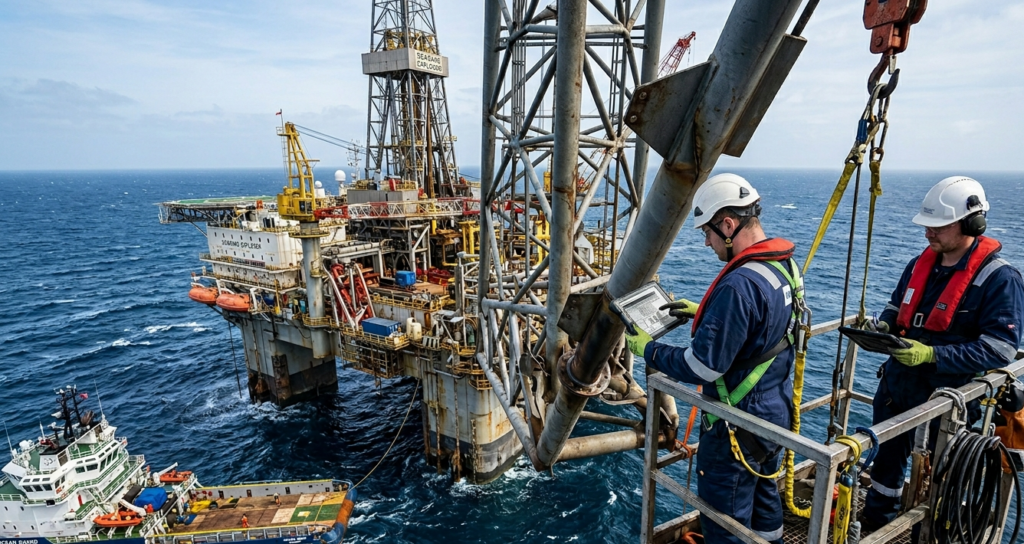
Offshore inspection programs generate high volumes of safety-critical data every day, but many rigs still rely on paper-based reporting that slows down decision-making and increases compliance risk. When inspection findings take days to reach the right people, small issues can escalate into expensive downtime events or regulatory violations. This guide breaks down the real operational and financial cost of paper inspections on offshore rigs and explains how digital inspection systems eliminate delays, reduce risk, and improve compliance performance.
The Hidden Cost of Paper Inspections on Offshore Rigs
The average offshore rig performs 15 to 25 safety-critical inspections every day. Hoisting equipment checks, BOP system evaluations, crane certifications, electrical system tests. Every inspection represents critical safety data. Yet many rigs still capture this data on paper clipboards, creating a cascade of operational and compliance problems that add up to $50,000 to $75,000 in annual cost per rig before accounting for incident-related losses.
The Bureau of Safety and Environmental Enforcement (BSEE) mandates rigorous inspection documentation for all offshore operations. However, paper-based programs routinely fail to meet these documentation standards, creating audit exposure every time an inspector walks on site.
Breaking Down the Annual Cost of Paper Inspections
Labor Costs: $50,000 Per Year in Pure Data Entry
Each inspection generates 2 to 3 pages of handwritten notes that someone must transcribe into digital systems. The math is straightforward: 20 inspections per day at 15 minutes of data entry per inspection equals 5 hours of data entry daily. At $40 per hour that is $200 per day, or $50,000 per year in labor that produces zero operational value.
Delayed Decisions Cost $400,000+ Per Incident
When a potential crane issue is identified on Day 1 and the paper report reaches the supervisor on Day 2, authorization comes Day 3, follow-up inspection Day 4, and maintenance begins Day 5. A 4-day delay on a safety-critical item that should have triggered same-day response. If this delay causes even 8 hours of production stoppage on a rig costing $50,000 per hour to operate, the cost of that single paper process failure exceeds $400,000.
Compliance Audit Failures: $25,000 to $75,000 Per Audit
Paper records create audit nightmares. Moreover, regulators cannot access inspection history remotely. As a result, missing documentation results in non-compliance findings. For example, a single audit typically uncovers 3 to 5 missing inspection records. Consequently, fines range from $10,000 to $25,000 per violation, putting a typical audit compliance failure at $50,000 to $150,000 in fines plus remediation costs.
Equipment Downtime from Inspection Inefficiency
A paper inspection takes approximately 2 hours per inspection when you include note-taking, photo organizing, and data consolidation. A digital inspection takes 45 minutes. That 75-minute reduction across 20 daily inspections equals 25 hours recovered per month. On a rig operating at $50,000 per hour, that recovered capacity is worth $1.25 million per month at full utilization.
Total Annual Cost of Paper Inspections Per Offshore Rig
- Data entry labor: $50,000 per year
- Compliance file management: $12,000 per year
- Report consolidation: $15,000 per year
- Equipment downtime from delayed inspections: $200,000 to $400,000 per year
- Production delays from late defect identification: $150,000 to $300,000 per year
- Audit penalties for missing documentation: $25,000 to $75,000 per year
Total annual cost: $452,000 to $852,000 per rig. Industry average: $650,000 per year.
Digital Inspection ROI for Offshore Operations
Field Eagle’s oil and gas inspection software replaces paper processes with a digital workflow purpose-built for offshore environments. Here is what the numbers look like.
Platform Investment
- Software subscription: $36,000 to $60,000 per year
- Implementation and training: $10,000 to $15,000 one-time
- Hardware (rugged tablets): $2,000 to $3,000 one-time
Year 1 Savings
- Elimination of data entry labor: $65,000 per year
- Equipment utilization recovery (conservative): $187,500 per year
- Compliance audit savings: $70,000 to $150,000 per year
Year 1 net return: $85,000 to $345,000. ROI: 100% to 435%. Payback period: 1 to 3 months.
Critical Inspection Categories on Offshore Rigs
Hoisting Equipment Inspections
- Wire rope condition assessment for broken strands or deformation
- Rigging hardware inspection for cracks, wear, or corrosion
- Hook and shackle evaluation for load rating compliance
- Load test documentation with date and certification reference
- Monthly competency verification for all hoisting operators
BOP System Testing
- Closure tests every 7 days minimum
- Flow tests monthly minimum
- Backup power system verification monthly
- Control system function checks weekly
- Maintenance interval tracking with automated alerts
Crane and Lifting Operations
- Daily pre-use inspections before any lifting operation
- Load capacity verification against current configuration
- Boom condition assessment for deformation or cracking
- Hydraulic system checks for leaks or pressure loss
- Operator certification tracking with expiry alerts
Electrical Safety Inspections
- Ground fault detection across all circuits
- Arc flash hazard assessment in high-voltage areas
- Equipment grounding verification
- Lockout/tagout compliance verification before maintenance
- High voltage system inspection by qualified personnel
How Field Eagle Transforms Offshore Inspection Programs
The Inspection Management Software platform gives offshore operations teams real-time visibility, automatic compliance documentation, and the offline capability that remote operations demand.
Works Without Internet
Field Eagle operates completely offline. Inspectors capture all data, photos, and measurements without connectivity. When the tablet syncs to the network, all data uploads automatically. No inspection data is ever lost due to connectivity failures. This is a non-negotiable requirement for offshore operations.
Instant Critical Defect Alerts
When an inspection identifies a critical defect, the platform sends immediate alerts to supervisors and emergency contacts. No waiting for reports to reach the office. No 4-day response cycle. Management knows about critical findings the moment they are documented.
Complete Compliance Documentation
Reports are generated automatically from inspection data. Moreover, every report includes photo documentation, inspector certifications, measurements, and timestamps. Therefore, regulators can audit your full inspection history instantly. As a result, missing records become impossible.
Fleet-Wide Trend Analysis
Field Eagle’s asset management software generates fleet-wide trend reports showing which rigs have recurring defect patterns, which equipment categories need maintenance focus, and where safety improvements are most needed. This transforms inspection data from compliance paperwork into operational intelligence.
Frequently Asked Questions
Typical implementation takes 2 to 4 weeks including platform setup, checklist customization for your rig configuration, tablet deployment, and inspector training. Most rigs transition fully within one deployment rotation cycle.
Offshore personnel adapt quickly when tools genuinely improve their work. Digital inspections complete faster, produce fewer errors, and provide immediate feedback. Adoption typically reaches 95%+ within 30 days.
Field Eagle works completely offline. All data captured offline syncs automatically when connectivity returns. No inspection data is ever lost due to connectivity failures.
Yes. Modern inspection tablets are rated for saltwater spray, high humidity, and extreme temperatures. Furthermore, rugged cases provide additional protection. As a result, the hardware investment of $200 to $300 per tablet pays back in the first month through inspection efficiency gains.
The platform synchronizes data across all inspectors in real time. Meanwhile, teams work independently, and all data consolidates automatically. As a result, team leads access a complete inspection status dashboard from any device.
Related Field Eagle Solutions
- Oil and Gas Inspection Software: fieldeagle.com/oil-and-gas-inspection-software/
- Inspection Management Software: fieldeagle.com/inspection-management-with-field-eagle/
- Asset Management Software: fieldeagle.com/asset-management-software/
- Digital Inspection Forms: fieldeagle.com/digital-inspection-forms-checklists/
- For the field checks, use drilling rig inspection checklist.
- Teams planning the next step can review oil rig inspection efficiency turn weeks into hours and top challenges oil rig inspections.
