
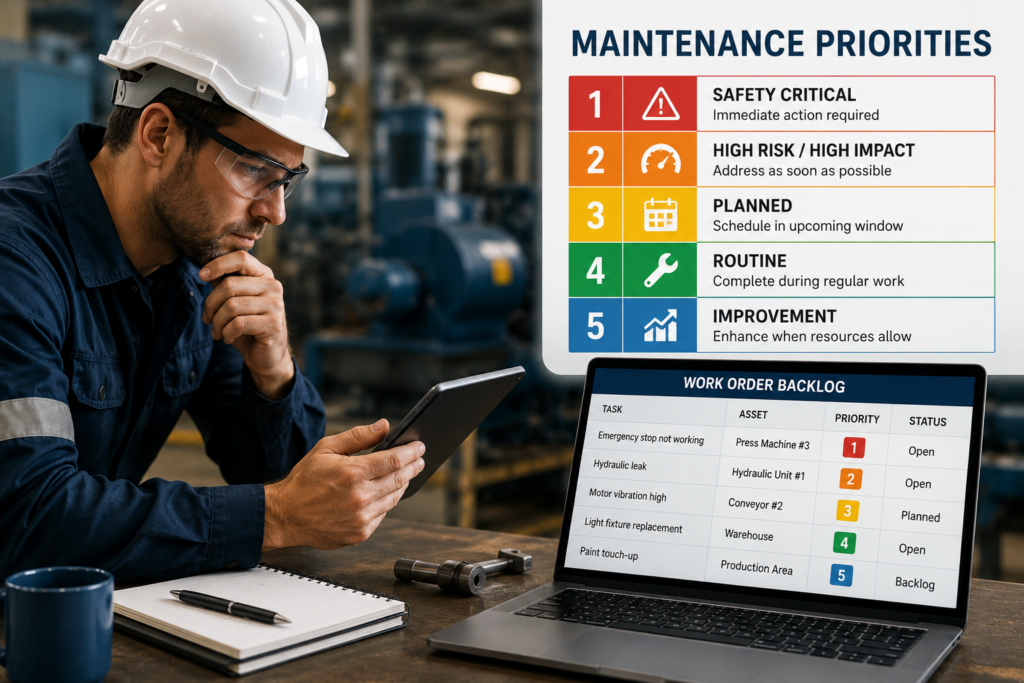
The maintenance list continues to grow.
One machine has started making an unfamiliar noise. Another has a small oil leak. A safety guard needs repair. A roof section shows water damage. Meanwhile, production wants a conveyor back online before the afternoon shift.
Every request sounds important. Several people call their issue urgent. However, the maintenance team has limited time, a limited budget, and only so many technicians.
Therefore, what should happen first?
Maintenance prioritization helps teams answer that question in a consistent way. Instead of reacting to the loudest request, the nearest manager, or the newest problem, teams compare each task using clear factors such as safety, asset condition, failure risk, operational impact, and available backup equipment.
Think of it like an emergency room. Doctors do not always treat patients in the order they arrive. They first look at who faces the greatest risk. Maintenance teams need a similar approach.
The goal is not to ignore lower-priority work. Instead, the goal is to make sure the most important work receives attention before delays create serious consequences.
What Is Maintenance Prioritization?
Maintenance prioritization is the process of ranking maintenance work based on urgency, risk, and business impact.
It helps teams decide:
- Which task needs immediate action
- Which asset can continue operating temporarily
- Which repair should enter the next planned shutdown
- Which work can wait
- Which issue needs monitoring rather than repair
- Where limited labour and money will create the most value
A strong process uses evidence rather than opinion.
For example, a leaking pipe near an electrical panel may deserve attention before a noisy office fan. A backup pump with minor wear may rank below the only pump serving a critical process.
Although the visible condition matters, it does not tell the whole story.
Therefore, teams must also consider what could happen if the asset fails.
Why “First Come, First Served” Does Not Work
A first-come, first-served system feels fair. However, it treats every maintenance request as though it creates the same level of risk.
Imagine that two work requests arrive on Monday morning.
The first request reports a broken handle on a storage cabinet. The second reports that an emergency generator failed its startup test.
The cabinet request arrived ten minutes earlier. Still, nobody would argue that it deserves attention first.
A simple maintenance queue also struggles when people describe urgency differently. One person may label everything “high priority” because they want a fast response. Another may avoid using the urgent category even when a problem creates real risk.
As a result, the priority labels soon stop meaning anything.
Therefore, a good system replaces personal urgency with shared rules.
Start With Safety
Safety should come before convenience, production speed, and repair cost.
A condition that could seriously harm someone may require immediate control, even when the asset still operates.
Examples include:
- Missing machine guards
- Damaged fall protection
- Exposed electrical parts
- Failed emergency stops
- Structural damage
- Gas or chemical leaks
- Fire protection failures
- Unsafe pressure conditions
- Equipment that could move unexpectedly
The first response may not involve a permanent repair. Instead, the team may need to stop the asset, isolate the area, reduce operating limits, or install a temporary barrier.
This is similar to finding water on the kitchen floor. Before you search for the source, you put up a warning sign or block access so nobody slips.
The temporary control reduces immediate risk. However, it does not replace the final repair.
Consider the Consequence of Failure
Next, ask what happens if the asset stops working or the defect becomes worse.
However, the answer may involve more than repair cost.
A failure could:
- Injure a worker
- Release a hazardous substance
- Stop production
- Interrupt water, power, heating, or ventilation
- Damage nearby equipment
- Affect product quality
- Delay customers
- Break a regulatory requirement
- Harm the environment
- Damage the organization’s reputation
The U.S. Environmental Protection Agency recommends that infrastructure managers consider both the likelihood of failure and the consequences of failure when they prioritize investments. It also advises them to identify which assets play a critical role in maintaining service. Read the EPA’s guidance for effective infrastructure decisions.
A failed drinking-water pump, for example, may affect public health. A failed decorative fountain pump creates a much smaller consequence.
Although both assets may need maintenance, they should not compete at the same level.
Look at the Likelihood of Failure
Consequence tells you how serious a failure would be. Likelihood tells you how close the asset may be to that failure.
Teams can estimate likelihood by reviewing:
- Current condition
- Inspection findings
- Operating hours
- Age
- Recent breakdowns
- Rising temperature
- Vibration trends
- Corrosion
- Leaks
- Unusual noises
- Maintenance history
- Manufacturer recommendations
- Environmental exposure
A critical asset in excellent condition may not need immediate repair. A less critical asset with severe damage may require action sooner.
Therefore, teams should avoid ranking work using only one factor.
Instead, risk usually comes from the combination of likelihood and consequence.
A basic model looks like this:
Maintenance risk = likelihood of failure × consequence of failure
You do not need advanced mathematics to use this idea. A simple low, medium, and high rating can work well when the definitions remain clear.
A risk-based inspection program can help teams gather the condition information they need to make these decisions.
Check Whether a Backup Exists
In addition, redundancy can change the urgency of a maintenance task.
Redundancy means that another asset can perform the same job if the first one fails.
For example, a facility may have two pumps that each handle the full required flow. If one pump develops a minor problem, the team may switch to the backup and schedule a controlled repair.
However, the same defect becomes more urgent when no backup exists.
Ask:
- Is there another asset that can perform the same function?
- Can the backup handle the full load?
- Has anyone tested the backup recently?
- How quickly can the team switch over?
- What happens if both assets fail?
- Does the backup already have unresolved defects?
However, a backup that has not run in two years may provide less protection than the team assumes.
The EPA’s asset management handbook advises organizations to consider remaining useful life, importance, and redundancy when ranking assets. Assets with no backup should generally receive greater attention because the system may struggle to continue operating without them. Read the EPA asset management handbook.
Do Not Confuse Poor Condition With High Priority
A badly damaged asset may catch everyone’s attention. Still, the worst-looking asset does not always deserve the first repair.
Consider two warehouse doors.
One door has heavy cosmetic damage but remains secure and operates safely. The other looks almost normal, but its safety sensor works only some of the time.
Although the first door looks worse, the second creates greater risk.
Condition asks:
What shape is the asset in?
Priority asks:
How soon does the organization need to act?
The answer depends on condition, risk, function, and available controls.
This is why reliable inspection data management matters. Teams need more than a list of defects. They need context about the asset, history, measurements, severity, and operational role.
Consider Operational Impact
Some equipment plays a direct role in production or service delivery.
A failure may:
- Stop an entire production line
- Slow output
- Create poor-quality products
- Prevent loading or shipping
- Delay a construction project
- Interrupt customer service
- Force expensive overtime
- Require an unplanned shutdown
However, teams should measure operational impact carefully.
People often describe their own equipment as essential. A simple process map can help reveal whether the asset truly controls the operation or merely creates inconvenience.
Ask:
- Which process depends on this asset?
- Can work continue at a lower rate?
- Can another line or site take over?
- How much downtime would a failure create?
- How many people or customers would it affect?
- What would one hour, one day, or one week of downtime cost?
As a result, this approach separates real production risk from pressure to complete routine work faster.
Include Environmental and Compliance Risk
Some maintenance delays create consequences that do not appear on a production report.
A damaged containment system, leaking tank, failed alarm, or malfunctioning ventilation system may create environmental or compliance problems.
Consider whether a delay could lead to:
- A spill or release
- Permit violations
- Missed inspections
- Failed emission controls
- Unsafe waste storage
- Incomplete records
- Regulatory penalties
- Mandatory shutdowns
- Reporting requirements
Therefore, these tasks may need high priority even when they do not affect current output.
The maintenance team should work with safety, environmental, quality, and compliance staff when the consequences fall outside normal equipment performance.
Factor in the Time Needed to Respond
Urgency and effort are different.
A critical repair may require a special part that takes six weeks to arrive. Meanwhile, a lower-risk issue may take only 20 minutes to fix.
However, the team should not ignore quick work simply because a major repair sits at the top of the list.
Instead, maintenance planners can manage several timelines at once:
- Immediate safety controls
- Emergency repairs
- Quick routine tasks
- Planned work
- Shutdown work
- Long-lead projects
- Capital replacements
For example, a team may isolate a failing pump today, order a replacement tomorrow, and complete several smaller tasks while waiting for delivery.
Ultimately, a priority system should guide attention without freezing all lower-level work.
Use a Simple Maintenance Priority Scale
A five-level system works well for many organizations.
Although the exact labels can change, each level should have a clear meaning.
Priority 1: Emergency
The issue creates an immediate threat to people, the environment, compliance, or essential operations.
Typical actions include:
- Stop work
- Isolate the asset
- Evacuate or restrict the area
- Apply immediate controls
- Begin emergency repair
- Notify responsible leaders
Examples include a major gas leak, exposed live wiring, structural instability, or failure of a critical safety system.
Priority 2: Urgent
The issue creates a serious risk, but immediate controls can keep the situation stable for a short period.
The team should respond quickly, often within hours or a few days.
Examples include a deteriorating critical component, a significant leak under control, or failure of the primary asset while a tested backup remains available.
Priority 3: Planned High Priority
The problem needs action soon, but the asset can operate safely under defined conditions.
The team may schedule the work during the next suitable maintenance window.
Examples include rising vibration, repeat seal failures, or wear approaching an acceptable limit.
Priority 4: Routine
The issue creates limited current risk.
The team can include it in normal maintenance planning.
Examples include minor adjustment, low-risk wear, non-critical lighting, or cosmetic damage that does not affect function.
Priority 5: Improvement
The task would improve efficiency, appearance, convenience, or long-term performance, but it does not address an active failure.
Examples include optional upgrades, layout improvements, and non-essential replacements.
The response time for each level should match the organization’s resources and risk profile.
A Practical Scoring Method
Some teams need more detail than a five-level label.
A simple score can help when many tasks compete for the same resources.
You might rate each factor from 1 to 5:
| Factor | 1 | 5 |
| Safety impact | Little or no hazard | Could cause severe injury or death |
| Environmental impact | No meaningful impact | Major release or reportable event |
| Operational impact | Minor inconvenience | Full shutdown or major service loss |
| Likelihood of failure | Unlikely | Failure appears imminent |
| Compliance impact | No requirement affected | Serious violation or mandatory shutdown |
| Redundancy | Full reliable backup | No backup available |
Add the scores to create an initial ranking.
However, do not let the number replace judgement. A low total should never hide a single life-threatening hazard.
Therefore, the score should support discussion rather than end it.
A Real-World Example: The National Park Service
The National Park Service manages tens of thousands of assets, including buildings, roads, trails, bridges, and water systems. It cannot repair every asset at the same time.
A U.S. Government Accountability Office review found that the agency used asset importance and condition to identify maintenance priorities. Projects received higher scores when they addressed critical assets with deferred maintenance.
At the end of fiscal year 2015, the National Park Service reported an $11.9 billion deferred maintenance backlog. Roads, bridges, tunnels, and other paved assets made up a large portion of it.
The case shows why a long repair list needs more than a due date. Managers must compare the role of each asset, its current condition, and the value of the proposed work. Read the GAO review of National Park Service maintenance prioritization.
Similarly, the same principle applies inside a factory or warehouse.
A company may not manage 75,000 assets, but it still needs to decide which pump, vehicle, roof section, safety device, or conveyor deserves funding first.
The Cost of Delaying the Wrong Work
Deferring maintenance does not always save money.
Instead, it may only move the cost into the future and allow it to grow.
A small roof leak can damage insulation, wiring, walls, equipment, and stored materials. A worn bearing can damage a shaft and motor. A minor pipe leak can lead to corrosion, contamination, or a larger release.
In 2025, GAO reported that federal building repair backlogs had more than doubled from $171 billion in fiscal year 2017 to $370 billion in fiscal year 2024. GAO warned that continued deterioration can force agencies to replace assets earlier, often at a much higher cost than timely maintenance and repair.
The lesson does not mean every task should become urgent. Instead, it shows why teams should understand the likely cost of delay.
Ask:
- Will the defect spread?
- Could it damage connected equipment?
- Will parts become harder to find?
- Could a planned repair turn into an emergency shutdown?
- Does the delay reduce the asset’s useful life?
- Will temporary controls create ongoing costs?
Consequently, this approach helps identify maintenance that protects the organization from larger future expenses.
Do Not Let the Loudest Person Set the Priority
Maintenance teams often receive pressure from several directions.
A production manager wants a machine fixed. A supervisor wants better lighting. A customer-facing team wants a cosmetic repair. A senior leader asks about an issue they noticed during a site visit.
Each request may have value. However, job title and persistence should not determine risk.
A shared priority system gives maintenance managers a clear explanation:
“We understand the request. Based on safety, operational impact, likelihood of failure, and available backup, this task ranks below two higher-risk repairs. We have scheduled it for Friday.”
As a result, that answer feels more credible than “We are busy.”
In addition, it helps reduce conflict between departments.
Review Priorities When Conditions Change
Maintenance priorities should not remain fixed forever.
A medium-priority task may become urgent when:
- The defect gets worse
- A backup asset fails
- Operating demand increases
- Severe weather approaches
- A replacement part becomes available
- A regulation or permit changes
- Another failure affects the same system
- Monitoring shows rapid deterioration
Likewise, a planned repair may move down when the team confirms that the condition remains stable.
Therefore, the priority should reflect current evidence.
Regular inspections and an inspection interval calculator can help teams decide how closely they need to monitor assets while maintenance remains pending.
How Maintenance Planners Can Manage the Backlog
A backlog does not need to become one endless list.
Maintenance planners can divide work into useful groups:
Immediate Controls
Actions that reduce current danger before the final repair.
Ready to Schedule
Work with a clear scope, available parts, labour, and approval.
Waiting for Parts
Tasks that cannot begin until materials arrive.
Requires Investigation
Problems that need testing, engineering, or more inspection data.
Shutdown Work
Repairs that require equipment or process downtime.
Capital Work
Large replacements or upgrades that need separate funding.
Monitor
Conditions that do not require immediate repair but need regular review.
Together, these groups make the backlog easier to understand. They also show why a task has not moved forward.
Measure More Than Completed Work Orders
Closing a large number of work orders does not always mean the team addressed the greatest risk.
A maintenance team can improve its numbers by completing many easy tasks while critical work stays open.
Useful maintenance metrics include:
- Number of emergency tasks
- Percentage of planned versus reactive work
- Critical work overdue
- Average response time by priority
- Repeat failures
- Time spent waiting for parts
- Work awaiting verification
- Backlog size by risk level
- Assets with repeated high-priority findings
- Maintenance linked to inspection findings
Ultimately, these measures show whether the team controls risk, not just whether it stays busy.
For more practical ways to manage cost and workload, see Field Eagle’s guide to smarter maintenance planning.
How Software Helps With Maintenance Prioritization
Software does not remove the need for human judgement. However, it can bring the right information together.
A connected system can help teams:
- View inspection findings
- Apply consistent severity levels
- Check asset criticality
- Review previous failures
- See open corrective actions
- Set due dates
- Track temporary controls
- Flag overdue work
- Compare locations
- Identify repeat defects
- Attach photos and measurements
- Build asset histories
Field Eagle’s asset maintenance software helps teams connect asset condition, inspections, and maintenance planning instead of managing each process in a separate file.
However, the important point is not simply to digitize the backlog.
A digital list can become just as confusing as a paper one when it lacks clear rules.
Instead, the system should help people understand why one task ranks above another.
A Better Question Than “What Should We Fix First?”
Teams often ask what they should fix first.
A stronger set of questions is:
- What creates the greatest current risk?
- What could fail soon?
- What would cause the greatest consequence?
- Which asset has no backup?
- What problem will become much more expensive if delayed?
- Which issue affects legal or safety requirements?
- What can we control temporarily?
- What information do we still need?
- Which repairs can we group together?
- What should we monitor while it waits?
As a result, these questions lead to better decisions because they focus on outcomes rather than pressure.
Prioritization Turns a Backlog Into a Plan
A maintenance backlog can feel overwhelming because it combines many different types of work in one place.
Some tasks protect people. Others prevent downtime. Some preserve equipment life. Others improve appearance or convenience.
Therefore, they should not all receive the same response.
A clear maintenance prioritization process considers:
- Safety
- Environmental impact
- Compliance
- Consequence of failure
- Likelihood of failure
- Asset condition
- Operational impact
- Redundancy
- Cost of delay
- Repair readiness
When teams use these factors consistently, the backlog becomes easier to explain and manage.
The maintenance team may still have more work than it can complete today. However, everyone can see which tasks come first, why they matter, and what happens next.
Ultimately, that is the real purpose of prioritization.
Frequently Asked Questions
Work that controls an immediate threat to people, the environment, compliance, or essential operations should usually come first. The team may need to isolate the asset or restrict access before completing the permanent repair.
Many organizations score factors such as safety impact, likelihood of failure, operational impact, compliance risk, asset condition, and redundancy. The final priority should also include professional judgement because one severe hazard may outweigh the total score.
Asset criticality describes how important the asset is to safety, service, or operations. Maintenance priority describes how quickly a specific task needs action. A highly critical asset in good condition may have no urgent work, while a lower-criticality asset with an active safety hazard may need immediate attention.
No. An active breakdown or serious hazard may need attention before scheduled preventive work. However, teams should protect enough time for preventive maintenance so urgent repairs do not consume the entire schedule and create more failures later.
Teams should review high-risk and overdue work frequently, often daily or weekly. They can review lower-priority work during regular planning meetings. They should also update priorities whenever asset condition, operating demand, backup availability, or risk changes.
