Pipeline integrity is one of the most consequential asset management challenges in oil and gas operations. Pipeline failures can result in product loss, environmental contamination, fire, explosion, and regulatory enforcement that can halt operations indefinitely. Yet pipeline networks are often the least visible assets in an operation, running through remote terrain, underwater, or underground where inspection is physically challenging.
This guide covers what pipeline inspection involves, the regulatory framework governing it, common failure modes that inspections target, and how pipeline inspection software makes pipeline inspection programs more systematic, better documented, and more effective at catching integrity issues before they become failures.
Why Pipeline Inspection Is Critical
Pipelines degrade through corrosion, mechanical damage, material fatigue, and ground movement. Left undetected, these degradation mechanisms eventually produce leaks, ruptures, or complete pipeline failures. In high-pressure systems carrying hydrocarbons, the consequences of undetected pipeline degradation can be severe and the liability exposure is significant.
Beyond safety and environmental protection, pipeline inspection is a regulatory requirement. PHMSA regulations in the United States, the National Energy Board regulations in Canada, and equivalent frameworks in other jurisdictions define minimum inspection requirements, integrity management program obligations, and documentation standards. Failure to maintain compliant pipeline inspection programs results in regulatory penalties and increased regulatory scrutiny. Standards compliance documentation must be available for regulatory review at any time.
Types of Pipeline Inspections
Right-of-Way Patrols
Regular right-of-way patrols inspect pipeline corridors for integrity concerns, encroachment, unauthorized excavation, and environmental changes. Typically, these frequent patrols provide the first warning of surface-level issues.
Above-Ground Inspection
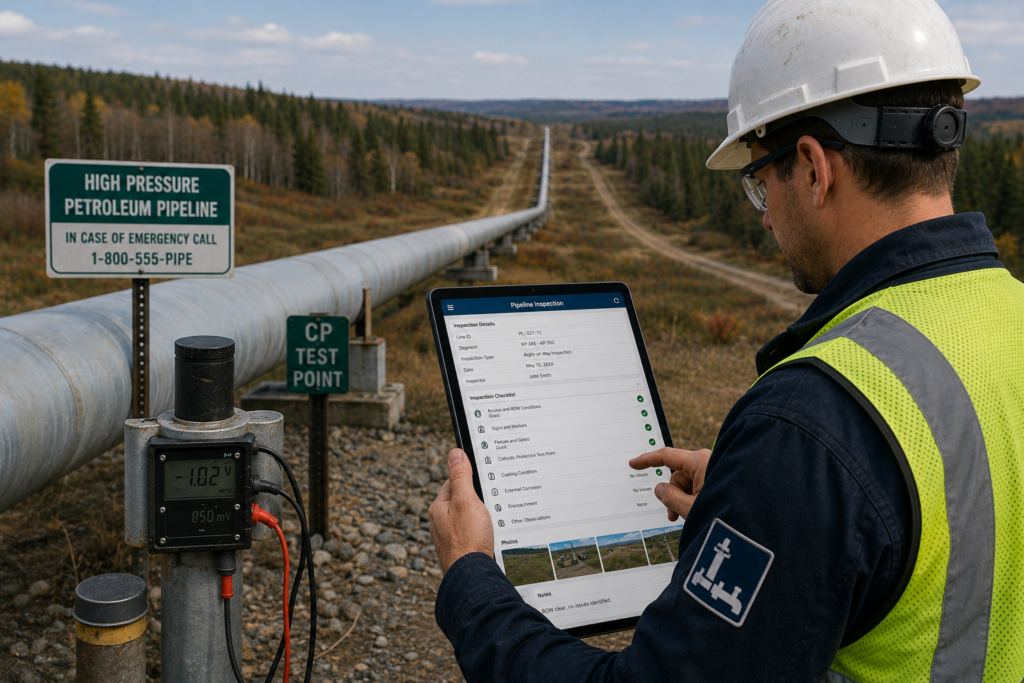
Above-ground inspection covers visible pipeline components including valve stations, meter stations, above-ground pipe segments, cathodic protection rectifiers, pipeline markers, and associated equipment. Inspection checklists for above-ground pipeline inspection cover corrosion assessment, coating condition, mechanical damage, valve and fitting integrity, and cathodic protection system functionality.
Inline Inspection
Inline inspection uses intelligent pigs to collect detailed data on wall thickness, metal loss, dents, and other integrity indicators. Although it provides comprehensive pipeline condition data, it requires operational planning, specialized tools, and expert analysis.
Cathodic Protection Surveys
Cathodic protection systems use electrical potential to prevent external corrosion on buried pipelines. Meanwhile, close-interval potential surveys measure system effectiveness and identify areas with inadequate protection or increased corrosion risk.
Hydrostatic Pressure Testing
Hydrostatic testing verifies pipeline structural integrity by pressurizing the line to a level above normal operating pressure. It confirms that a pipeline can withstand operating pressure and identifies weaknesses before service resumes. Typically, regulations require testing after construction, major repairs, and at defined intervals for certain pipeline classifications.
Common Pipeline Failure Modes Inspection Targets
External Corrosion
External corrosion of buried or submerged pipeline is the most common degradation mechanism. It occurs where coating has failed and cathodic protection is inadequate. External corrosion produces pitting and metal loss that reduces pipe wall thickness and can eventually cause leakage or rupture.
Internal Corrosion
Internal corrosion occurs where the pipeline product contains water, CO2, H2S, or other corrosive constituents that react with the pipe wall. It is particularly common in crude oil and natural gas gathering pipelines and can produce rapid metal loss in areas where water accumulates.
Mechanical Damage
Third-party mechanical damage from excavation, construction activity, or agricultural equipment is a leading cause of pipeline incidents. Right-of-way patrols and marker inspection help identify excavation activity near the pipeline route. Damage assessment inspections after near-miss incidents or reported excavation in the ROW are critical for identifying impact damage before it causes failure.
Stress Corrosion Cracking
Stress corrosion cracking occurs at the intersection of tensile stress, a corrosive environment, and susceptible material. It produces colonies of cracks that can propagate to failure under normal operating pressure. SCC is challenging to detect because it produces tight cracks that are difficult to find through standard inspection methods.
How Pipeline Inspection Software Improves Integrity Programs
Paper-based pipeline inspection programs struggle with consistency, documentation quality, and the ability to trend inspection data across inspection cycles. Digital pipeline inspection software addresses these limitations through several key capabilities.
Standardized ROW Patrol and Above-Ground Inspection Forms
Digital inspection checklists enforce consistent inspection procedures across all inspectors and inspection cycles. Every patrol covers the same items in the same way. Deviations from standard conditions are documented with photos and specific descriptions rather than general notes. The consistency that digital checklists enforce is essential for trend analysis to be meaningful.
GPS-Tagged Findings
Inspection findings tagged with precise GPS coordinates can be mapped to specific locations on the pipeline route. This allows inspection teams to return to exactly the same location on subsequent inspections to assess whether conditions have changed. It also supports integration with GIS mapping systems for spatial analysis of pipeline integrity data.
Corrective Action Tracking
Every integrity finding generates a corrective action with assigned owner, due date, and priority based on severity and regulatory requirements. The complete corrective action lifecycle is tracked from identification to verified resolution. This systematic tracking ensures no finding is lost between the field inspection team and the pipeline integrity engineering group.
Inspection History and Trend Analysis
Every inspection adds to the pipeline segment’s condition history. Over time, this history reveals corrosion progression rates, recurring mechanical damage locations, and cathodic protection effectiveness trends. This longitudinal data is the foundation of risk-informed pipeline integrity management that goes beyond fixed-interval inspection programs.
Regulatory Documentation
PHMSA, NEB, and other regulatory agencies require detailed documentation of pipeline integrity management programs including inspection records, threat assessments, and corrective action histories. Digital inspection software maintains this documentation automatically in a searchable database that can produce required records for regulatory review without manual compilation.
Frequently Asked Questions
In the United States, PHMSA regulations, including 49 CFR Parts 192 and 195, govern natural gas and hazardous-liquid pipeline inspections. Meanwhile, Canada’s energy regulators, including the CER and AER, oversee pipeline integrity programs. Together, these regulations establish minimum inspection frequencies, assessment methods, and documentation requirements.
Pipeline classification, integrity threats, and regulations determine inspection frequency. Typically, teams conduct right-of-way patrols weekly or monthly and inspect above-ground facilities annually. Meanwhile, inline inspections usually occur every 3 to 10 years, depending on corrosion rates, previous findings, and regulatory requirements.
An inline inspection tool, or pig, travels through a pipeline using product flow. For example, pigs use magnetic flux leakage, ultrasonic testing, or caliper measurements to detect metal loss, dents, and wall-thickness changes. Afterward, analysts use the collected data to produce a detailed pipeline condition report.
Pipeline inspection software uses GPS to record each finding’s precise coordinates. As a result, teams can map findings, export them to GIS systems, and return to exact locations during future inspections. Moreover, GPS tagging replaces unclear location descriptions with precise spatial data.
Typically, a right-of-way patrol checklist covers pipeline markers, third-party encroachment, excavation activity, and signs of leakage. In addition, it includes surface erosion, exposed facilities, cathodic protection test stations, and environmental changes that could affect pipeline integrity.