Update cookies preferences

Oilfield Inspection Management Software for Upstream and Midstream Operations

Field Eagle oilfield inspection management software gives upstream and midstream operations teams the tools to manage wellsite safety inspections, facility integrity assessments, pipeline right-of-way patrols, and production equipment condition programs from one central platform. Built for the specific challenges of oilfield operations – remote locations without connectivity, hazardous environments requiring intrinsically safe equipment, rotating crews, and overlapping regulatory frameworks from OSHA, PHMSA, AER, and API. Every inspection links to the specific asset or location it relates to and generates compliance documentation automatically.

Full offline for remote wellsites and pipeline corridors.  API, PHMSA, OSHA, and AER compliance documentation.  AI predicts equipment failures from inspection history.

No obligations, See how it works for yourself.

What Is Oilfield Inspection Management Software?

Oilfield inspection management software is a platform that manages the planning, scheduling, execution, documentation, and follow-up of all inspection programs across upstream and midstream oil and gas operations. This includes wellsite safety inspections, production facility integrity assessments, pressure vessel inspection programs, pipeline right-of-way patrols, above-ground storage tank inspections, and all other systematic inspection activities required by API standards, PHMSA regulations, AER directives, and OSHA requirements.

Oilfield inspection management has specific requirements that general inspection software cannot meet. Wellsites and pipeline corridors are remote, often without cellular or satellite connectivity. Inspection teams are rotating crews who need access to consistent inspection procedures and the inspection history of assets they may not have personally visited before. Regulatory frameworks are complex and overlapping. Field Eagle oil and gas inspection software is built for all of these specific requirements.

oil gas inspections

Oilfield Inspection Programs Field Eagle Manages

Wellsite Safety Inspections

Pre-job safety meetings and documentation, wellsite hazard assessments, H2S monitoring and safety equipment verification, wellhead and production equipment condition checks, containment and spill prevention inspections, and emergency equipment readiness verification. OSHA and API RP 54 compliance documentation for all drilling and well servicing operations. See: oil and gas inspection software.

Pressure Vessel Inspection Programs

API 510 pressure vessel external and internal inspection programs linked to individual vessel records. Corrosion rate calculations supported by longitudinal thickness measurement data. Pressure relief valve condition and testing records. Remaining life assessments based on accumulated inspection data. See: asset integrity management software.

Pipeline Right-of-Way Patrols

PHMSA and AER compliant pipeline right-of-way patrol documentation. Encroachment reporting, soil movement observations, above-ground facility condition checks, cathodic protection test point readings, and leak patrol documentation. GPS-tagged findings linked to specific pipeline segments. See: pipeline inspection software.

Above-Ground Storage Tank Inspections

API 653 external visual inspection programs linked to individual tank records. Shell condition, coating assessment, secondary containment integrity, pressure vacuum valve condition, and overfill protection device verification. AER Directive 055 compliance documentation for Alberta operators. See: tanks and silos inspection software.

Production Facility Integrity Assessments

Process piping inspection programs under API 570, fired equipment inspections, heat exchanger condition assessments, mechanical equipment condition monitoring, electrical system safety inspections, and environmental compliance checks. All linked to the specific equipment asset records in the facility register. See: risk based inspection software.

Environmental Compliance Inspections

SPCC inspection programs, emissions monitoring documentation, produced water management compliance checks, and environmental permit compliance verification. EHS software documentation meeting EPA, AER, and provincial environmental requirements.

Built for Oilfield Operational Conditions

Full Offline for Remote Locations

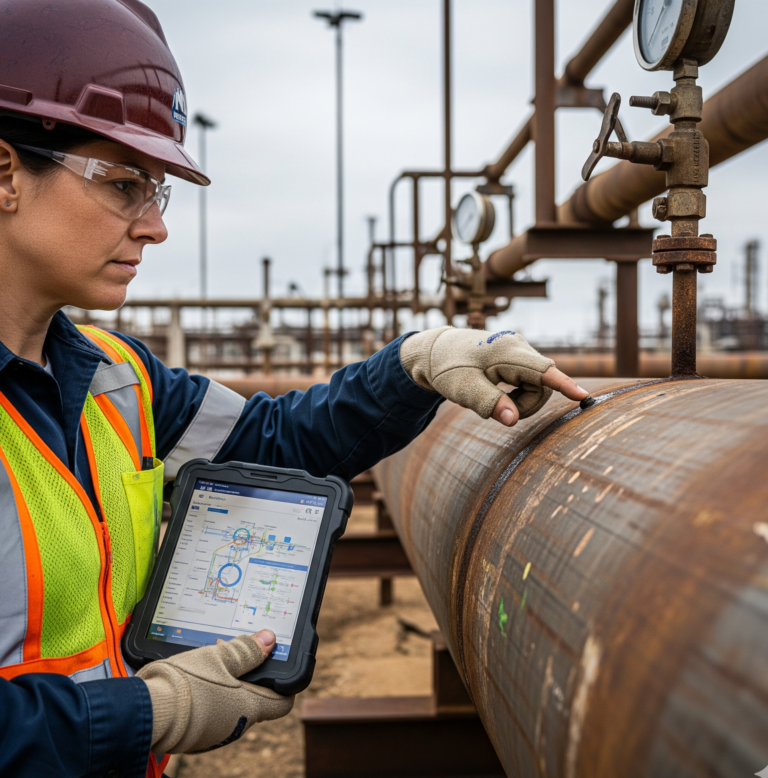
Wellsites, pipeline corridors, and remote production facilities frequently have no cellular coverage and no wifi. Field Eagle operates fully offline on tablets. Inspection teams complete the full inspection, capture photos, record GPS coordinates, and enter all data without connectivity. Everything syncs automatically when the tablet connects to a network. No inspection is compromised by the remoteness of the location.

Rotating Crew Consistency

Rotating crews create inspection inconsistency in paper-based programs. Different crews document differently. Asset condition history is lost between rotations. Field Eagle's standardized digital inspection checklists enforce consistent inspection procedures regardless of which crew is on site. Asset condition histories are available to every crew from day one. New crew members see what the previous crew found on every asset they inspect.

Rugged Tablet Support for Hazardous Environments

Oilfield environments include classified areas where standard consumer electronics cannot be safely used. Field Eagle supports MIL-STD-810 rated intrinsically safe tablets designed for hazardous area classification zones. Your inspection teams use appropriately rated devices for the environments they work in.

Multi-Site Portfolio Management

Oilfield operations span multiple wellsites, pipeline segments, and production facilities across large geographic areas. Field Eagle manages inspection programs across unlimited sites from one central platform. Operations managers monitor inspection completion, overdue items, and open corrective actions across the entire portfolio from the management dashboard.

What Our Clients Say About Us

Regulatory Compliance for Oilfield Operations

  • API 510 pressure vessel inspection and remaining life assessment documentation
  • API 570 above-ground piping inspection documentation
  • API 580 and API 581 risk-based inspection methodology implementation
  • API 653 above-ground storage tank inspection documentation
  • API RP 54 drilling and well servicing safety documentation
  • PHMSA 49 CFR Parts 192 and 195 pipeline inspection and patrol documentation
  • OSHA 29 CFR 1910.119 Process Safety Management compliance documentation
  • EPA 40 CFR Part 112 SPCC inspection program documentation
  • AER Directive compliance for Alberta oil and gas operations
  • CER requirements for federally regulated Canadian pipeline operations

Frequently Asked Questions

Field Eagle is a Field Inspection Software and an Asset Inspection Software. it is a fully customizable inspection software that allows companies and agencies in conducting Inspections that are Regulatory body compliant. This Inspection Managment software can be integrated with any ERP or software to make your inspections much simpler to Manage as well.

Oilfield inspection management software centralizes field inspections, equipment records, findings, corrective actions, and reports.

Field Eagle helps teams schedule inspections, complete digital forms, document defects with supporting evidence, and monitor unresolved findings across wellsites, production facilities, and other oilfield operations. Its broader inspection management software capabilities connect fieldwork with management oversight.

An oilfield inspection solution should include configurable forms, offline data collection, equipment histories, corrective-action tracking, and automated reporting.
Field Eagle connects inspection responses, photographs, measurements, signatures, deficiencies, and follow-up work within one system. This gives field and management teams a traceable record from the initial inspection through verified resolution.

Yes. Field Eagle provides centralized visibility into inspections, findings, overdue work, and corrective actions across multiple oilfield locations.

Managers can monitor activity across wellsites, production facilities, and other locations without compiling separate spreadsheets or paper reports. Field Eagle’s inspection data management capabilities keep records organized and accessible from one platform.

Yes. Field Eagle connects equipment inspections, condition records, defects, and maintenance findings to the relevant equipment record.

Teams can review previous inspection results, identify recurring equipment problems, and confirm whether corrective actions were completed. This creates a usable inspection history for planning maintenance and monitoring equipment condition. Learn more about asset inspection software.

Yes. Field Eagle can manage configurable inspection workflows for midstream and downstream energy operations.
Teams can use it for pipelines, terminals, storage tanks, processing equipment, facilities, and supporting infrastructure. Forms, inspection schedules, evidence requirements, and reports can be configured for different assets, locations, and operating requirements.

Field Eagle stores oilfield safety inspections, photographs, notes, signatures, timestamps, findings, and corrective-action histories in one searchable system.

This reduces dependence on paper files and disconnected spreadsheets. Authorized teams can retrieve supporting records when preparing internal reviews, client reports, safety audits, or regulatory documentation. Field Eagle can also be configured around applicable requirements through its standards and compliance workflows.

Yes. Field Eagle maintains a traceable history of inspection activity, findings, changes, assignments, and corrective-action completion.

The audit trail helps demonstrate when an inspection occurred, who completed it, what was identified, and how the organization responded. This supports more consistent audit management and reporting.

Yes. Field Eagle allows inspection teams to complete oilfield inspections without cellular or Wi-Fi coverage.
Inspectors can complete forms, record measurements, attach photographs, and document findings on a tablet while offline. The collected information synchronizes with the central platform when connectivity becomes available.