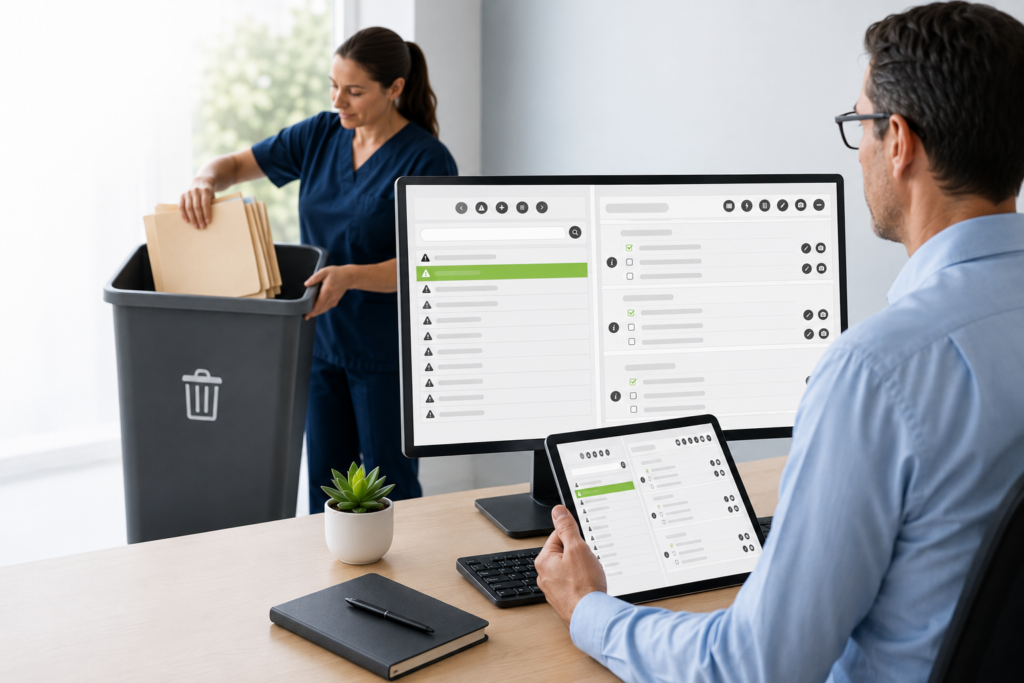
The audit trail used to live in three-ring binders. Here is why that no longer cuts it.
If you manage a hospital, ambulatory surgery center, or large clinic, you already know that a Joint Commission survey is not a casual check-in. It is a structured, evidence-based audit of nearly every system in your facility, from fire door signage in a stairwell to the calibration records on a defibrillator. Surveyors expect documentation. They expect consistency. And they expect it on demand.
The problem is that most healthcare facilities are still trying to meet a 21st-century accreditation standard with 20th-century tools: spreadsheets, printed checklists, and shared drives full of PDFs no one has opened since the last survey. That gap is where facilities fail, not because the work is not being done, but because the proof is missing.
This article breaks down how modern inspection software changes that equation, and includes a real-world example of a 200-bed hospital that cut its Joint Commission prep time by 60 percent.
What Joint Commission Actually Expects (And Where Facilities Struggle)
Think of Joint Commission accreditation like a commercial building inspection, but instead of one inspector checking one thing, you have a team reviewing six overlapping domains at once: Environment of Care, Life Safety, Infection Prevention and Control, Emergency Management, Equipment Maintenance, and Human Resources. Every domain has its own inspection cadence, documentation requirements, and corrective action standards.
The most common findings during Joint Commission surveys fall into predictable categories:
- Missed or undocumented recurring inspections (fire drills, extinguisher checks, door hardware rounds)
- Equipment maintenance records that are incomplete or stored inconsistently
- Teams identified deficiencies internally but never formally tracked them through resolution.
- Staff identified infection control lapses during walk-throughs but assumed someone else was monitoring them.
- Environment of Care surveys that relied on memory rather than verified rounds
None of these are signs of a negligent facility. They are signs of a facility managing complexity without the right infrastructure. The good news is that
inspection management software directly addresses each one.
How Inspection Software Supports Joint Commission Readiness
1. Automated Scheduling for Recurring Inspections
One of the clearest requirements in Joint Commission standards is inspection frequency. Fire drills must happen at specified intervals. Teams must check medical equipment on a defined schedule. In addition, facility staff must conduct and document facility rounds.
Healthcare inspection software automates this scheduling so nothing falls through the cracks. Think of it as a recurring maintenance plan for heavy equipment. First, the system identifies when a task is due and alerts the responsible person. Then, it tracks whether the team completes the task on time. As a result, the software manages the schedule without relying on someone’s memory.
For Joint Commission purposes, this creates an unbroken timeline of activity. Every drill, every equipment check, every facility round has a timestamp, an assignee, and a completion record. That is the kind of documentation surveyors look for, and the kind that takes hours to assemble manually.
2. Real-Time Deficiency Flagging
When a facilities technician finds a broken fire door closer or damaged electrical panel cover during a routine round, the next steps directly affect accreditation. However, in a paper-based system, the technician records the issue on a clipboard and hands it to a supervisor. The supervisor may later enter it into a spreadsheet, unless someone loses the paperwork first.
With digital inspection forms, deficiencies are flagged the moment they are observed. The inspector notes the finding in the mobile app, attaches a photo, and the system automatically assigns a work order, sets a corrective action deadline, and notifies the responsible team member. The deficiency is in the system before the inspector has left the floor.
For Joint Commission compliance, surveyors need more than confirmation that teams corrected deficiencies. Specifically, they expect a complete lifecycle: identification, assignment, resolution, and verification. Therefore, software automatically creates this audit trail, while spreadsheets do not.
3. Audit Trails That Hold Up Under Scrutiny
Consider this oil and gas analogy: teams would never approve a pipeline inspection without a tamper-evident record of every step. Similarly, Joint Commission expects hospital facilities teams to meet the same standard. Therefore, the system must time-stamp every inspection entry, identify the inspector, and prevent unauthorized changes.
Modern inspection platforms like Field Eagle generate audit trails that are built into the system architecture. Records cannot be backdated or quietly edited. When a surveyor asks for the last six months of fire extinguisher inspection logs, the facilities director can pull a formatted, date-ordered inspection report in minutes, not hours.
4. On-Demand Compliance Documentation
Joint Commission surveys can involve extended document reviews. Surveyors may request evidence across multiple departments and time periods simultaneously. In a paper or spreadsheet environment, assembling that documentation is a multi-day sprint that facilities and compliance teams dread.
Inspection software changes this to a few clicks. Because all inspection data is centralized and tagged by category, location, equipment type, and date, compliance reports can be generated on demand, filtered exactly to what the surveyor is asking for. The data is already organized. The report is already formatted. The team can respond in real time rather than scrambling.
CASE STUDY
How a 200-Bed Hospital Reduced Joint Commission Prep Time by 60%
A regional acute care hospital with 200 licensed beds completed two Joint Commission surveys within five years. However, both surveys produced Requirement for Improvement findings because teams maintained incomplete or inconsistent documentation, not because they failed to perform the required work. The facilities team was competent. Their system was not. Read more case studies like this on the Field Eagle case studies page.
Before adopting digital inspection software, the facilities director estimated that survey preparation consumed about three weeks of staff time across the compliance, facilities, and risk management departments. Specifically, teams spent most of that time locating, reconciling, and formatting records that should have remained organized throughout the year.
After implementing a digital inspection platform, the hospital standardized its inspection workflows across the Environment of Care, Life Safety, and medical equipment categories. Recurring inspections were scheduled in the system. Deficiencies were tracked to closure using prebuilt templates aligned to Joint Commission domains. All documentation was centralized.
At the next Joint Commission survey, the prep window dropped from three weeks to under nine days. The facilities director attributed the reduction almost entirely to documentation accessibility: everything was already in one place and ready to export.
As a result, the survey proceeded more smoothly. The facilities team fulfilled surveyors’ document requests on the same day, and surveyors issued no corrective action findings for documentation gaps.
The Specific Joint Commission Domains Where Software Makes the Biggest Difference
Not every part of a Joint Commission survey is equally documentation-intensive, but several domains benefit directly and immediately from inspection software:
| Domain | Where Software Helps Most |
| Environment of Care (EC) | Scheduled facility rounds, deficiency tracking, life safety equipment checks |
| Life Safety (LS) | Fire drill documentation, door and egress inspections, alarm testing records |
| Infection Prevention (IC) | Environmental audits, hand hygiene observations, construction risk assessments |
| Equipment Management (EM) | Preventive maintenance scheduling, calibration records, equipment inventory |
| Emergency Management | Drill documentation, after-action reports, plan review records |
What to Look for in Healthcare-Specific Inspection Software
Not all inspection platforms are built for the complexity of a healthcare environment. A general-purpose checklist app may work for a retail location. It will not hold up in a 400-room hospital where regulatory requirements vary by floor, department, and equipment category.
Here is what to evaluate when selecting a platform for Joint Commission readiness:
- Joint Commission framework alignment: The platform should support the specific standards categories (EC, LS, IC, EM) rather than requiring you to retrofit a generic template.
- Corrective action workflows: Deficiency identification is only half the job. The system needs to track findings from open to resolved, with accountability at each step.
- Role-based access and accountability: Different inspectors, department heads, and compliance officers need different views of the same data.
- Mobile-first design: Inspectors are walking floors and equipment rooms. The tool needs to work on a phone or tablet without requiring a laptop.
- Export and reporting flexibility: Surveyors ask for data in specific ways. Your software should generate reports filtered by date range, domain, location, or equipment type in minutes.
- Prebuilt templates for healthcare: Starting from scratch wastes time. Look for a platform with inspection form templates built around common regulatory frameworks.
- Asset and equipment management: Medical equipment records need to live in the same system as your inspection records, not a separate spreadsheet.
The Bigger Picture: Continuous Survey Readiness vs. Survey Sprints
There is an old joke in healthcare compliance: facilities teams spend two years ignoring documentation and two weeks panicking about it. The joke is funny because it is true. And it is the single most preventable source of Joint Commission stress.
The shift that digital inspection software enables is moving from survey sprints to continuous readiness. When inspections are completed on schedule and documented automatically, when deficiencies are tracked to closure in real time, and when compliance documentation is available on demand, there is no sprint. The data is always current. The documentation is always organized.
Think of it the way an experienced plant manager thinks about regulatory inspections in a refinery or utility facility: the goal is not to pass the inspection. It is to operate in a way where passing the inspection is a natural byproduct of how you run the plant every day. Healthcare facilities are starting to adopt the same mindset. See how similar logic applies in oil and gas inspection workflows and utilities inspection management, two industries that have been running continuous compliance programs for decades.
Field Eagle also publishes resources to help facilities teams get ahead of their next survey, including whitepapers, infographics, and a blog covering compliance and inspection topics across industries.
Final Thought
Joint Commission accreditation will not become simpler. Moreover, annual standard updates and workforce turnover strain institutional knowledge, while failed surveys create costs far beyond the review itself.
Therefore, successful facilities teams build the right infrastructure months before surveyors arrive. They use software to manage documentation while employees focus on keeping the facility safe. Ultimately, that is what joint commission inspection software helps teams accomplish. Learn more about how Field Eagle supports health and safety inspection workflows or explore the full platform overview to see where it fits in your facility management stack.
Frequently Asked Questions
Joint Commission inspection software is a digital platform that helps healthcare facilities schedule, conduct, document, and report on inspections required for accreditation. It replaces paper checklists and spreadsheets with a centralized system that generates audit trails, flags deficiencies in real time, and produces compliance reports on demand. See how Field Eagle approaches this.
As a result, the system helps teams complete every required inspection on time and document it consistently. When surveyors request records, teams can export organized data within minutes. In addition, the system tracks every corrective action through resolution, preventing open loops. The result is a facility that walks into a survey with evidence already in order, rather than scrambling to assemble it. Explore Field Eagle’s compliance features for more detail.
Yes. Equipment maintenance is one of the most documentation-heavy areas of Joint Commission compliance. A good platform will track preventive maintenance schedules, calibration records, and service histories for every piece of equipment in the facility, linked to the asset itself rather than stored in a separate spreadsheet. See Field Eagle’s asset maintenance software and asset management features.
Implementation timelines vary depending on facility size and how much existing data needs to be migrated. Most facilities are running standardized inspections within a few weeks of onboarding. Platforms with prebuilt templates and digital inspection forms aligned to regulatory frameworks significantly reduce setup time.
Yes. Field Eagle serves a wide range of regulated industries including oil and gas, utilities, construction, manufacturing, and mining. The underlying platform is the same: scheduled inspections, real-time deficiency tracking, and on-demand compliance reporting.