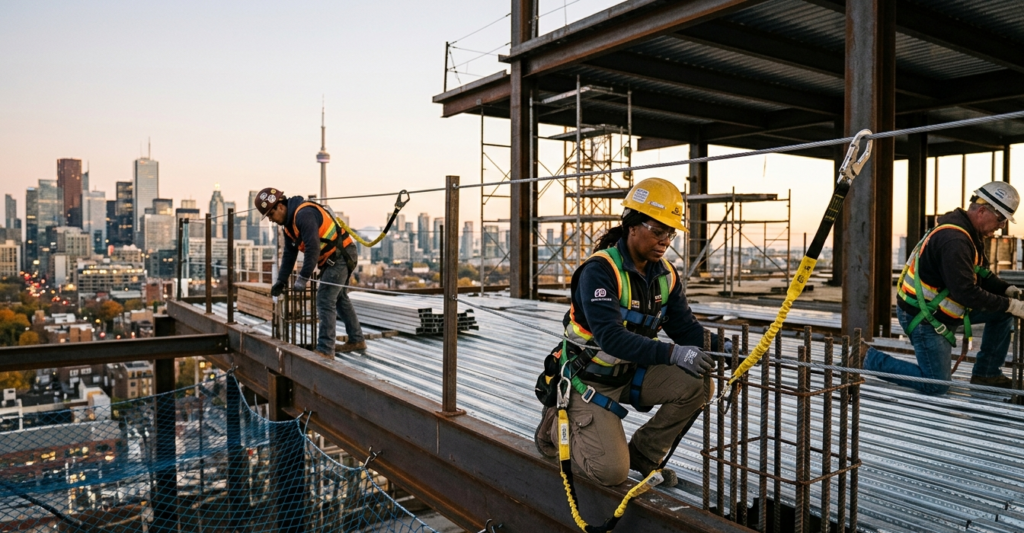
Most fall protection failures are preventable. Damaged harnesses, expired equipment, inadequate anchor points, and missed inspections are common issues that place workers at serious risk and expose companies to major OSHA penalties. A consistent inspection program helps identify these problems before they lead to injuries, shutdowns, or compliance violations. This guide covers the key OSHA requirements, inspection procedures, and digital compliance practices every safety team should follow.
Fall Protection Requirements Under OSHA
OSHA 1926.501 requires fall protection for all workers at heights of 6 feet or greater in construction. For general industry, the threshold is 4 feet. For maritime and shipyard operations, 5 feet. The OSHA fall protection standards specify exactly what type of protection is required for each situation: personal fall arrest systems, guardrail systems, or safety net systems.
Statistics that define the urgency of fall protection compliance:
- Falls cause approximately 36 percent of all construction worker fatalities annually
- More than 7,000 fall protection citations issued by OSHA each year
- Average penalty per fall protection citation: $15,000 to $20,000
- Willful violations: up to $156,259 per citation
- Fall-related worker death: $150,000+ in fines, potential criminal charges
Fall Protection Equipment Inspection Requirements
Pre-Use Inspection (Before Every Use)
Every person who uses fall protection equipment must inspect it before each use. This is an OSHA requirement, not a recommendation. A pre-use inspection takes 2 to 3 minutes. A missed inspection that fails to catch a damaged shock absorber can result in a fatal fall.
Harness Inspection Checklist
- Webbing: no cuts, tears, abrasion burns, or chemical damage
- All stitching intact with no loose or broken threads
- D-rings firmly attached with no cracks or deformation
- Buckles function smoothly and latch securely
- No corrosion on any metal components
- Manufacture date label readable and within service life
- Size label visible and matches wearer
- No exposure to high heat, paint, or chemical solvents
Lanyard and Connector Inspection
- Lanyard webbing: no cuts, abrasion, or UV degradation
- Rope core intact with no reduction in diameter
- No burn marks or chemical staining
- Connector body free of cracks or deformation
- Gate function smooth and closes completely with audible click
- Load rating clearly marked and appropriate for application
- No corrosion on connector body or gate
Shock Absorber Inspection
- Deployment indicator shows not previously activated (intact stitching)
- Outer casing intact with no tears or openings
- Cushion material present and not compressed
- Within manufacturer service life (typically 5 years)
- Inspection label attached and readable
Self-Retracting Lanyard Inspection
- Retract and extend function operates smoothly throughout full range
- Arrest function activates at correct speed
- No unusual noise during operation
- Casing free of cracks, dents, or deformation
- Swivel attachment moves freely without binding
- Inspection and service current per manufacturer schedule
Anchor Point Inspection
- Anchor point rated for 5,000 pounds minimum per person
- Structural engineer assessment completed if capacity uncertain
- Anchor connection hardware secure with no corrosion or damage
- Designed for repeated use, not one-time attachment points
- Positioned to minimize fall distance and swing fall hazard
- Clearance below work area calculated to prevent ground contact
Detailed Inspection Schedule
Pre-Use Inspection (Before Each Use)
Required for every user before every use. Firstly, the person who will wear the equipment conducts the inspection. Typically, it takes 2 to 3 minutes and is documented in the equipment log or inspection checklist. However, any deficiency requires immediate removal from service.
Competent Person Inspection (Monthly)
Conducted by a trained and authorized competent person. Covers all equipment in the inventory. More thorough than pre-use inspection. Includes functional testing, measurement of webbing deterioration, and assessment of equipment history. Documents current condition and remaining service life.
Formal Inspection and Certification (Annual)
Third-party inspection and certification for equipment approaching end of manufacturer service life. Some equipment categories require annual third-party certification. Provides independent documentation of equipment condition for regulatory and legal purposes.
Equipment Retirement Criteria
Fall protection equipment must be immediately retired from service when any of the following occur:
- Shock absorber deployed after any fall (stitching torn open)
- Equipment involved in a fall regardless of visible damage
- Any cut, tear, abrasion damage to webbing
- Chemical, heat, or UV damage that degrades material strength
- Connector crack, deformation, or gate malfunction
- Manufacturer service life reached (check label on each piece)
Retired equipment must be physically destroyed before disposal to prevent accidental reuse. Cut harnesses in multiple locations. Crush connectors. Mark equipment clearly as DO NOT USE before placing in waste.
Common Fall Protection Deficiencies and Penalties
Deployed Shock Absorber Returned to Service
Shock absorbers are single-use devices. Any deployment tears the internal stitching and destroys the energy-absorbing function. Returning a deployed shock absorber to service is a willful violation. Penalty: $15,000 to $156,259. Detection: inspect the indicator window or seam stitching on every pre-use inspection.
Inadequate Anchor Point
Workers attaching lanyards to structural elements that cannot withstand 5,000 pounds of load. Penalty: $15,000 to $25,000. Prevention: pre-identify all approved anchor points and document their ratings. Digital systems can store anchor point records accessible to every inspector.
Equipment Beyond Service Life
Harnesses and lanyards have manufacturer-specified service lives, typically 5 to 10 years from manufacture date. Equipment beyond service life remaining in use is a serious violation. Penalty: $12,000 to $18,000. Prevention: track manufacture dates for every piece of equipment. Digital inventory systems automate service life tracking and alert before expiry.
How Digital Inspection Systems Strengthen Fall Protection Compliance
Field Eagle’s construction inspection software maintains a complete inventory of all fall protection equipment with manufacture dates, service life calculations, inspection history, and deployment records. When a piece of equipment approaches end of service life, the system generates a replacement alert.
According to OSHA’s fall protection guidance, documentation of inspection programs is critical to demonstrating a systematic approach to fall hazard control. Digital records provide this documentation automatically.
Field Eagle’s safety compliance software links every pre-use inspection to the specific equipment piece, creating a chain of custody record that proves each inspection was performed by a specific person at a specific time and location.
Frequently Asked Questions
Pre-use inspection before every use is mandatory. Monthly competent person inspection for actively used equipment. Annual formal inspection for equipment approaching end of service life.
Fall prevention stops the fall from occurring: guardrails, covers, warning lines. Fall arrest stops a fall in progress: harness and lanyard systems. OSHA requires fall prevention where feasible. Fall arrest where prevention is not feasible.
Anchor points must be rated for 5,000 pounds per attached person. If the rating is unknown or the structural element was not designed as an anchor, have a structural engineer assess and certify it before use.
Remove the worker from the fall protection equipment immediately (do not reuse it). Provide medical assessment even if no obvious injuries. Remove all equipment involved from service. Investigate the incident to identify whether the anchor failed, equipment failed, or the system was rigged incorrectly.
Storage does not extend or replace service life. Equipment must be inspected before first use regardless of storage duration. Extended storage in poor conditions (UV exposure, chemical fumes, temperature extremes) can degrade equipment faster than use. Inspect before storage and before return to service.
Related Field Eagle Solutions
- Construction Inspection Software: fieldeagle.com/construction-inspection-software/
- Safety Compliance Software: fieldeagle.com/safety-compliance-software/
- Health and Safety Software: fieldeagle.com/health-safety-inspection-software/
- Standards Compliance Software: fieldeagle.com/standards-compliance/
- To explore the topic in more detail, see fall maintenance audit best time review.