API 653 compliance plays a critical role in maintaining the safety, reliability, and operational lifespan of aboveground storage tanks in the oil and gas industry. These tanks store hazardous materials that can create serious environmental, financial, and safety risks if inspections and maintenance are not properly managed. The API 653 standard outlines the inspection, repair, alteration, and reconstruction requirements operators must follow to keep tanks safe and compliant throughout their service life.
Therefore, facility managers and operations teams must understand these requirements to prevent leaks, avoid costly shutdowns, and reduce regulatory exposure. In addition, this guide explains the key inspection requirements, recommended inspection intervals, and complete API 653 tank inspection checklist your team can use to support a consistent and compliant inspection program.
What Is API 653 and Why Does It Matter?
API 653 is the American Petroleum Institute standard for Tank Inspection, Repair, Alteration, and Reconstruction. It governs inspection, maintenance, and repair of aboveground storage tanks in petroleum service. You can review the full standard at API.org. For oil and gas operators, this is not a bureaucratic requirement. It is a direct liability and safety obligation that protects your business from consequences that cannot be reversed.
Non-compliance results in:
- Environmental fines of $25,000 to $50,000+ per violation
- Operational shutdowns that halt revenue generation entirely
- Loss of insurance coverage leaving your assets exposed
- Criminal liability for facility managers in cases of negligence
- Reputational damage affecting customers and business partners
Field Eagle’s oil and gas inspection software is purpose-built to help operations teams meet API 653 requirements without relying on paper checklists that create compliance gaps.
API 653 Inspection Frequency Requirements
API 653 mandates three distinct inspection types with specific frequency requirements based on tank age, contents, and condition.
External Inspections
At a minimum, teams must conduct external inspections annually. Specifically, these inspections cover tank shell condition, corrosion evaluation, coating integrity, nozzle connections, and foundation assessment. Therefore, they establish a baseline for tracking deterioration over time and serve as the most frequent compliance touchpoint in your program.
Internal Inspections
Teams must conduct these inspections every 5 to 10 years, depending on tank age and service conditions. Specifically, inspectors enter the confined space to examine welds, measure tank bottom thickness, evaluate internal corrosion patterns, and assess the internal coating. Because these inspections require significant resources, teams must coordinate contractors and maintain documented compliance records.
Ultrasonic Thickness Testing
Required every 5 years minimum. Ultrasonic testing measures remaining metal thickness at multiple points on the tank shell and bottom. According to EPA spill prevention regulations, if corrosion exceeds 0.05 inches per year, annual measurements become required. The data feeds directly into corrosion rate calculations that determine whether your inspection schedule needs acceleration.
Complete API 653 Tank Inspection Checklist
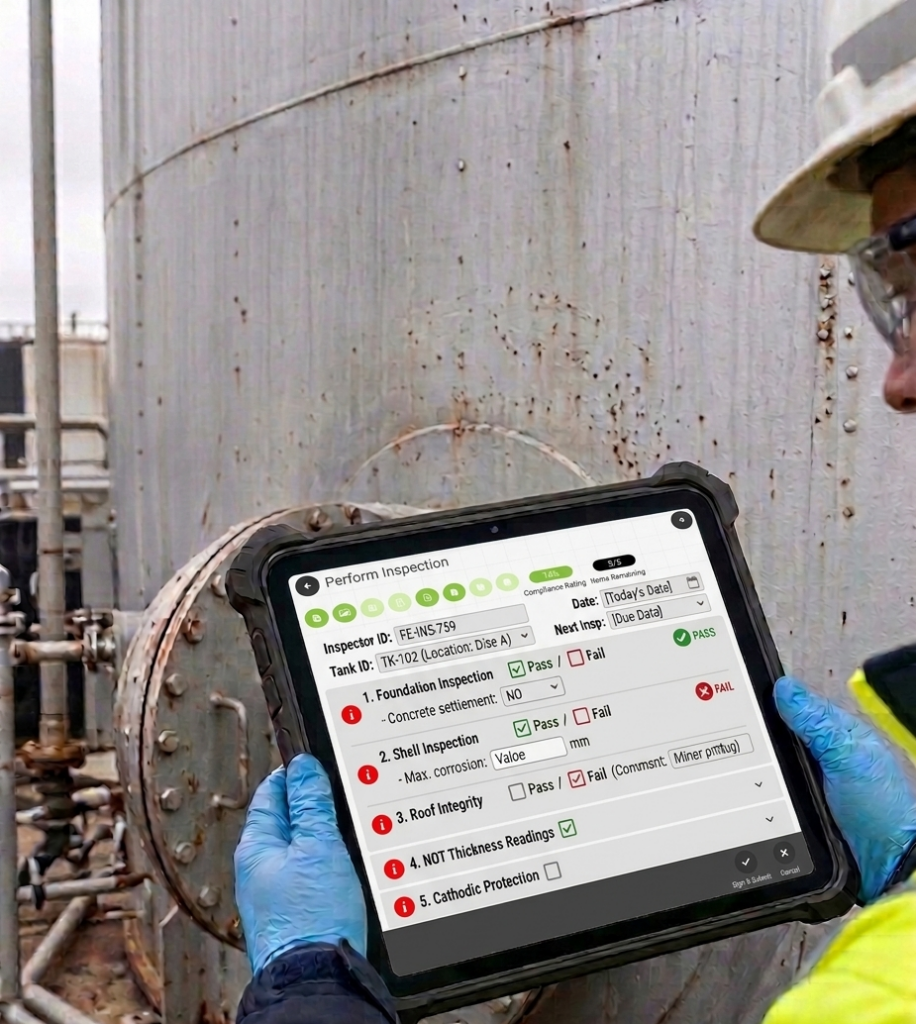
Use this checklist alongside Field Eagle’s tanks and silos inspection software to capture all findings digitally with photo documentation and automatic compliance reporting.
Pre-Inspection Planning
- Review complete tank history and all previous inspection reports
- Identify tank contents and assess compatibility issues
- Determine whether internal entry is required for this inspection cycle
- Develop safe work procedures including hazard identification and mitigation
- Schedule inspection during planned operational downtime
- Brief all inspection personnel on scope, hazards, and emergency procedures
External Visual Inspection
- Inspect tank shell for visible corrosion, pitting, or surface degradation
- Check for dents, bulges, or structural deformation anywhere on shell
- Evaluate coating condition and assess extent of paint deterioration
- Inspect all seams for signs of leakage, weeping, or staining
- Check all bolted connections for tightness and corrosion
- Assess support structure for rust, corrosion, or structural degradation
- Inspect foundation for cracks, differential settlement, or erosion
- Check nozzle connections and flanges for corrosion and leak indicators
- Evaluate ladder and platform condition for structural integrity
- Inspect roof or floating cover condition and sealing effectiveness
Corrosion Assessment
- Measure shell thickness at a minimum of 8 equally spaced locations
- Document all measurement locations with photos and GPS references
- Calculate corrosion rate by comparing to previous inspection measurements
- Identify any localized corrosion areas requiring more intensive assessment
- Assess internal corrosion patterns if internal inspection is being conducted
- Evaluate potential for stress corrosion cracking based on contents and temperature
- Check effectiveness of cathodic protection system if installed
Weld and Seam Evaluation
- Complete visual inspection of all visible welds on shell and roof
- Check welds for cracking, porosity, undercut, or incomplete fusion
- Evaluate weld overlay condition at high-wear or high-stress locations
- Inspect seam areas for signs of fatigue cracking from thermal cycling
- Check for signs of previous repairs and assess repair quality
- Assess weld quality against API 653 acceptance criteria
Safety Systems Verification
- Verify pressure relief valve operation and confirm calibration is current
- Check all temperature monitoring equipment for calibration and function
- Inspect emergency drain systems for blockage and operational readiness
- Evaluate ventilation system integrity and flow rate adequacy
- Verify handrail and ladder safety meet current code requirements
Documentation Requirements
- Photograph all areas of concern with date and time stamps
- Record all measurements with precise locations, dates, and inspector identification
- Document all repairs needed with priority classification and recommended timeline
- Record inspector credentials, certifications, and API authorization number
- Establish baseline measurements for all thickness readings for future trending
- Flag all items exceeding API 653 action limits for immediate remediation planning
Common API 653 Inspection Failures and How to Prevent Them
Understanding where inspection programs fail is as important as knowing what to inspect. These are the most common failure patterns that lead to non-compliance.
Corrosion Exceeding Safe Limits Between Inspections
Tanks in aggressive environments can lose wall thickness faster than your inspection interval accounts for. If corrosion rate exceeds 0.05 inches per year, a 5-year inspection cycle may allow a tank to reach scrap thickness before your next assessment. Shorten inspection intervals based on your calculated corrosion rate and use continuous ultrasonic monitoring between formal inspections to detect acceleration early.
Weld Integrity Failures
Weld cracks develop progressively from thermal cycling, vibration, or manufacturing defects that were initially sub-threshold. Implement radiographic testing on high-risk welds and track weld condition trends across multiple inspection cycles to catch deterioration before it reaches critical levels.
Coating System Deterioration
Protective coatings fail faster than replacement budget cycles in many operations. Once the coating fails, the underlying tank shell corrodes faster. Therefore, teams should conduct annual coating assessments and plan for replacement every 5 to 7 years. Although coating maintenance costs $15,000 to $50,000 per tank, emergency shell replacement can cost $200,000 to more than $500,000.
Foundation Settlement
Support structure subsidence creates uneven stress across tank welds and nozzle connections. Measure settlement at each inspection and establish action thresholds that trigger corrective work before critical failure occurs.
How Digital Inspection Tools Ensure API 653 Compliance
Paper-based inspection programs create compliance gaps regardless of team diligence. Inconsistent data capture, lost documentation, delayed reporting, and disconnected photos all create regulatory exposure. Field Eagle’s inspection management platform eliminates these vulnerabilities and creates audit-ready documentation automatically.
Standardized Checklists Enforce Consistency
Digital inspection software enforces identical data capture across every inspector, every inspection, every time. Items cannot be skipped, fields cannot be left blank, and measurements must be entered in the correct format. This eliminates the variation that creates compliance gaps when different inspectors use different approaches.
Photo Documentation Proves Inspection Thoroughness
Every finding requires photo documentation attached directly to the checklist item. GPS tagging proves the photo was taken at the correct location. Timestamps prove when it was captured. This creates unassailable compliance evidence for regulatory auditors and insurance assessors.
Automated Compliance Tracking Prevents Missed Intervals
The system tracks inspection intervals for every tank in your fleet automatically. Supervisors receive alerts when an inspection is approaching its due date. When an API 653 action limit is exceeded, the system flags it immediately. No manual tracking required. No missed inspection cycles.
Complete Asset History for Trending
Every thickness measurement, corrosion finding, weld anomaly, and repair is stored in a complete asset history. Field Eagle’s asset management software enables trending analysis that identifies accelerating corrosion before it reaches action limits, replacing emergency responses with planned maintenance events.
Offline Capability for Remote Operations
Oil and gas tank farms frequently operate in areas with limited connectivity. Field Eagle works completely offline. Inspectors capture all data, photos, and measurements without internet. When the device syncs, all data uploads automatically. No inspection data is ever lost due to connectivity failures.
The Business Case for Structured API 653 Compliance
The cost of non-compliance far exceeds the cost of a structured compliance program. A single failure can result in a $50,000 environmental fine, a $200,000 emergency tank repair, and $500,000 in production downtime during unplanned shutdown. A structured digital inspection program typically costs $3,000 to $10,000 per year. Against potential exposure of $750,000+, the return on investment is clear.
Frequently Asked Questions
API 650 is the design standard for new aboveground storage tanks. API 653 is the maintenance standard for tanks already in service, governing inspection intervals, repair requirements, and fitness-for-service assessments. Once a tank is commissioned, API 653 governs its inspection program for its entire operational life.
API 653 requires measurements at 5-year intervals minimum. If your calculated corrosion rate exceeds 0.05 inches per year, conduct measurements annually or semi-annually. Operations in saltwater environments or with aggressive contents typically require more frequent testing.
No. API 653 establishes mandatory internal inspection intervals based on tank age and service conditions. Deferral exposes your operation to significant regulatory penalties and eliminates the ability to detect internal corrosion and weld defects that external inspection cannot reveal.
Maintain complete inspection reports, all ultrasonic thickness measurements with locations, photographic documentation, repair history, coating maintenance records, and inspector certifications for the operational life of the tank.
API 653 inspections must be conducted by an Authorized Inspector employed by a recognized inspection organization, your company, or your insurance authority. Inspectors must hold current certification per API RP 579.
Related Field Eagle Solutions
- Tanks and Silos Inspection Software
- Oil and Gas Inspection Software: fieldeagle.com/oil-and-gas-inspection-software/
- Standards Compliance Software: fieldeagle.com/standards-compliance/
- Inspection Management Software: fieldeagle.com/inspection-management-with-field-eagle/