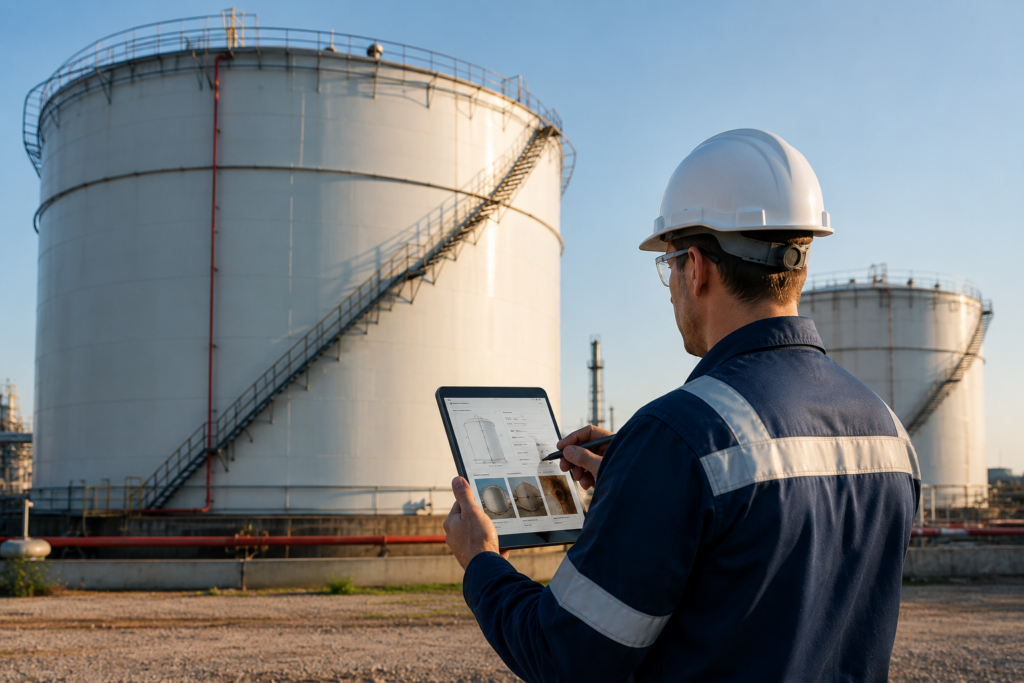
Storage tanks are among the most regulated assets in oil and gas and utilities operations. They hold hazardous materials under pressure or at elevated temperatures, often in large quantities, and failure can result in environmental contamination, fire, explosion, or worker injury. Regular, systematic tank inspection is not optional. It is a regulatory requirement and an operational necessity.
This guide covers the key types of tank inspections, the regulatory standards that govern them, common defects inspectors look for, and how tank inspection software makes inspection programs more consistent, better documented, and easier to manage.
Types of Tank Inspections
In-Service Inspection
Teams conduct in-service inspections while the tank remains operational. Typically, inspectors assess visible areas for corrosion, coating condition, and structural integrity. As a result, they can identify many defects without emptying, cleaning, or entering the tank.
Out-of-Service Inspection
Out-of-service inspections require teams to empty, clean, and prepare the tank for entry. As a result, inspectors can thoroughly examine the shell, floor, and roof for corrosion, pitting, cracks, and structural defects. Typically, API 653 and other regulatory standards define the required inspection intervals.
External Visual Inspection
Regular external visual inspection covers the tank shell, roof, foundation, vents, drains, valves, and associated piping. Inspectors look for visible corrosion, paint failure, structural deformation, settlement, drainage issues, and any signs of leakage. External inspections are typically the most frequent type and form the baseline of any tank inspection program.
Floor Inspection
Floor inspections assess the tank bottom, which is especially vulnerable to internal corrosion and pitting from water and sediment accumulation. For example, inspectors use ultrasonic thickness measurements, magnetic flux leakage scanning, and visual checks of accessible areas.
Roof Inspection
Fixed roof inspection covers the structural condition of the roof plate, rafters, and supporting columns. Floating roof inspection also covers the pontoon condition, seal integrity, and drainage system. Roof failures can lead to product contamination, vapor emissions, and structural collapse.
Regulatory Standards Governing Tank Inspections
In oil and gas and utility operations, several key standards govern tank inspections. Specifically, these standards define inspection requirements, intervals, and documentation. Compliance with these standards is a regulatory obligation, not just a best practice.
API 653
API 653 governs the inspection, repair, alteration, and reconstruction of steel above-ground storage tanks. It defines minimum inspection intervals for in-service and out-of-service inspections, assessment methods for corrosion and remaining life calculations, and requirements for documentation of inspection findings. API 653 is the primary standard for aboveground storage tank inspection in North America.
API 570
It governs the inspection, rating, repair, and alteration of in-service piping systems, which includes piping associated with storage tank systems. Tank inlet and outlet piping, overflow lines, and drain systems fall under API 570 requirements alongside the API 653 requirements for the tank itself.
API 650
API 650 covers the design and construction of welded steel tanks for oil storage. While primarily a design standard, it establishes the baseline construction requirements that inspectors use when assessing whether tank components meet original design specifications.
EPA and Provincial Environmental Regulations
Environmental regulations governing underground and aboveground storage tanks add requirements beyond the API standards, particularly around spill containment, leak detection, and release reporting. Operations must maintain inspection documentation that demonstrates compliance with both the technical inspection standards and the environmental regulatory requirements.
Common Defects Found During Tank Inspections
Corrosion
Corrosion is the most common defect found during tank inspections. External corrosion affects the tank shell and roof, particularly in areas where protective coatings have failed. Internal corrosion affects the floor and lower shell where water accumulates. Corrosion reduces wall thickness and can eventually lead to perforation and leakage.
Settlement
Tank settlement refers to vertical movement of the tank bottom due to foundation compression or erosion. Differential settlement, where one side of the tank settles more than another, creates stress on the shell, roof, and connected piping that can lead to cracking and leakage if not addressed.
Coating Failure
External and internal protective coatings prevent corrosion but deteriorate over time due to UV exposure, temperature cycling, chemical exposure, and mechanical damage. Coating failure exposes the underlying steel to corrosive conditions and accelerates wall thinning.
Structural Deformation
Tank shells and roofs can deform due to over-pressure, vacuum, wind loading, or seismic events. Deformation affects the structural integrity of the tank and can indicate that safety devices are not functioning correctly.
Weld Defects
Weld defects including cracking, incomplete fusion, and porosity can develop in the original construction welds or in repair welds. They are typically identified through non-destructive testing methods including ultrasonic testing and radiographic inspection.
How Digital Inspection Software Improves Tank Inspection Programs
Paper-based tank inspection programs struggle to maintain the consistency, documentation quality, and trend visibility that API 653 and other standards require. Digital tank inspection software addresses these limitations through several key capabilities.
- Standardized inspection checklists that ensure every API 653 required item is covered consistently regardless of which inspector conducts the inspection
- Photo documentation attached directly to specific inspection items for visual evidence of defects and coating condition
- Thickness measurement recording linked to specific locations on the tank for trend analysis across inspection cycles
- Corrective action generation from failed inspection items with assigned owners and tracked resolution
- Inspection schedule enforcement with automatic alerts when inspections are due and escalation when overdue
- Audit-ready documentation that meets API 653 record-keeping requirements without manual compilation
Frequently Asked Questions
API 653 sets inspection intervals based on corrosion rates and remaining life. Typically, teams inspect tank exteriors annually and adjust the schedule according to risk. Meanwhile, a qualified inspector or corrosion engineer sets internal intervals, which cannot exceed 20 years. Check out out Asset Interval Calculator to know inspection intervals for all assets.
API 653 requires an authorized inspector to conduct or supervise inspections. Typically, the inspector needs relevant tank experience, knowledge of applicable standards, and API certification. Therefore, organizations often use API 653-certified third-party companies for compliance inspections.
API 653 requires documentation of inspection findings including inspection date, inspector identity, inspection methods used, areas inspected, defects found, thickness measurements, remaining life calculations, corrective actions recommended, and next inspection due date. Records must be maintained for the life of the tank and be available for regulatory review.
Teams conduct in-service inspections while tanks remain operational, using external and accessible internal methods. In contrast, out-of-service inspections require teams to empty, degas, clean, and prepare tanks for entry. Although more comprehensive, these inspections increase costs and disrupt operations.
Tank inspection software ensures every required API 653 inspection item is completed consistently, captures thickness measurements linked to specific tank locations for trend analysis, automatically generates corrective actions from deficiency findings, maintains inspection records in a searchable database that meets API 653 documentation requirements, and schedules inspections based on remaining life calculations with automatic alerts when inspections are due.