NASPO Certified
Field Eagle gives oil and gas teams the tools to conduct right-of-way patrols, above-ground facility inspections, and integrity assessments on a tablet in the field, document findings with GPS coordinates and photos, track corrective actions from identification to resolution, and maintain the compliance documentation that PHMSA, AER, and API 570 require. All of it connected to a centralized pipeline inspection database that makes records retrievable in seconds.
Tablet-based and fully offline for remote pipeline corridors. GPS-tagged findings linked to specific pipeline locations. Supports API 570, PHMSA, AER, and pipeline integrity management standards.
No obligations, See how it works for yourself.
Pipeline inspection software is a digital platform that manages the field inspection activities, data capture, corrective action tracking, and compliance documentation for pipeline integrity management programs. It replaces paper-based inspection processes with structured digital workflows that capture consistent data, connect findings to specific pipeline locations, and maintain the audit-ready records that regulatory frameworks require.
Pipeline inspection programs face specific challenges that generic inspection tools are not built to handle. Pipeline corridors are remote, connectivity is unreliable, findings must be geo-located precisely on the route, inspection data must build longitudinal condition histories for individual pipe segments, and compliance documentation must satisfy overlapping regulatory frameworks simultaneously. Field Eagle is built to handle all of these requirements while connecting pipeline inspection data directly to the asset integrity management systems that drive remediation decisions.
Â
Field Eagle closes every one of these gaps. ROW patrol data is structured and searchable. Findings are GPS-tagged to precise locations. Corrective actions are tracked automatically. Compliance documentation is retrievable in seconds. Condition histories build across inspection cycles. And the platform operates fully offline on remote pipeline corridors.
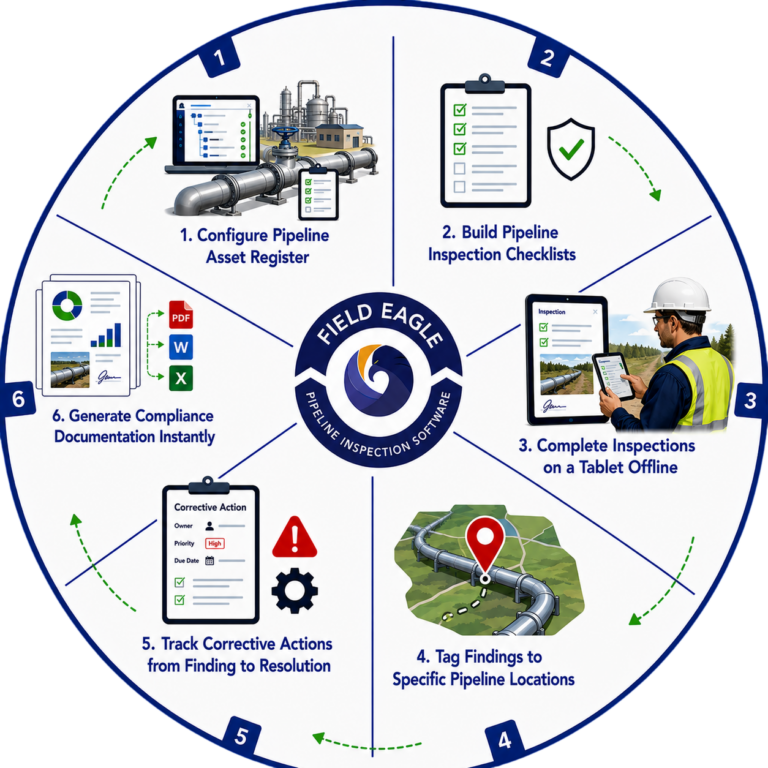
Build a structured register of your pipeline system in Field Eagle's asset management platform covering line segments, above-ground facilities, valve stations, meter stations, cathodic protection systems, and associated infrastructure. Each pipeline segment stores specifications, operating parameters, inspection history, and compliance documentation. Asset hierarchies reflect the structure of your pipeline network.
Create standardized inspection checklists for ROW patrols, above-ground facility inspections, cathodic protection surveys, valve and meter station checks, and any other pipeline inspection type in your program. Checklists are configured for the specific inspection requirements of your pipeline system, regulatory jurisdiction, and applicable standards including API 570.
Pipeline inspection reports and compliance documentation generate automatically from field data. PHMSA, AER, and API 570 documentation requirements are met without manual compilation. When regulators request inspection records, they are retrieved and presented immediately. Complete inspection histories for any pipeline segment are available in seconds.
Pipeline inspectors complete inspections on a tablet along the ROW and at above-ground facilities. Field Eagle operates fully offline, which is essential for remote pipeline corridors without cellular coverage. Findings are documented with GPS coordinates, photos, condition ratings, and notes. All data syncs to the central database when connectivity is restored. No connectivity required during inspection.
Every integrity finding generates a corrective action with assigned owner, priority, and due date. Managers track resolution progress from the central dashboard. Complete corrective action histories are linked to specific pipeline locations and inspection records, creating the audit trail that integrity management programs require.
Every finding is tagged with precise GPS coordinates that pinpoint its location on the pipeline route. This allows inspection teams to navigate directly to the location of previous findings on subsequent inspection cycles, and enables spatial analysis of integrity findings across the pipeline system. GPS-tagged findings can be integrated with GIS mapping systems.
Complete ROW patrols and facility inspections on a tablet without any internet connectivity. Essential for remote pipeline corridors. All data syncs automatically when connectivity returns. No data loss regardless of connection availability.
Inspection records maintained in formats that satisfy API 570, PHMSA 49 CFR Parts 192 and 195, AER, and other applicable regulatory requirements. Audit-ready documentation retrievable in seconds for regulatory reviews.
Integrity findings automatically generate corrective actions with assigned owners and due dates. Track resolution from identification to verified closure. Complete audit trail linked to specific pipeline locations and inspection records.
Standardized digital checklists for right-of-way patrols covering encroachment, surface conditions, markers, and environmental changes. Structured records enable trend analysis across patrol cycles.
Every finding tagged with precise GPS coordinates. Navigate directly to previous finding locations on subsequent inspections. Spatial analysis of integrity findings across the pipeline route. GIS integration capability.
Longitudinal condition histories for individual pipeline segments and above-ground facilities. Track how conditions change across inspection cycles. Identify segments with accelerating deterioration rates.
Structured documentation of cathodic protection survey results linked to specific test point locations. Track CP system performance trends. Identify areas of inadequate protection requiring remediation.
Manage inspection programs across multiple pipelines and systems from one centralized platform. Compare performance between lines. Standardize inspection processes across the portfolio.
Field Eagle pipeline inspection software maintains documentation that satisfies the requirements of the key regulatory frameworks governing pipeline integrity programs. All compliance records are stored and retrievable automatically:
Field Eagle supports the full range of pipeline inspection types including right-of-way patrols, above-ground facility inspections, valve and meter station checks, cathodic protection surveys, pipe coating condition assessments, and integrity management documentation. Inspection checklists are configurable for any pipeline inspection type and can be aligned with API 570, PHMSA, or other applicable standards.
Yes. Field Eagle runs on tablets and operates fully offline. Pipeline inspectors complete full ROW patrols and facility inspections including GPS tagging, photo capture, and all checklist items without any internet or cellular connectivity. All data syncs automatically to the central database when connectivity is restored. This offline capability is essential for pipeline inspection programs where ROW corridors often have no reliable connectivity.
When an inspector documents a finding during a ROW patrol or facility inspection, Field Eagle records the precise GPS coordinates of the finding automatically using the tablet’s GPS receiver. These coordinates are stored with the finding record, enabling navigation back to the exact location on subsequent inspection cycles, spatial mapping of findings along the pipeline route, and integration with GIS systems for pipeline integrity data analysis.
Field Eagle supports API 570 compliance by providing inspection checklists configurable for API 570 inspection requirements, maintaining timestamped and signed inspection records that satisfy API 570 documentation standards, tracking corrective actions from findings to verified resolution with complete audit trails, and making all inspection records retrievable instantly for regulatory reviews. Risk based inspection scheduling can also be implemented to align inspection frequency with API 570 risk-informed intervals.
Yes. Field Eagle manages inspection data across unlimited pipeline systems, lines, and facilities from one centralized platform. Pipeline asset registers, inspection histories, corrective action records, and compliance documentation for all systems are stored in the same database. This enables cross-system performance comparison, standardized inspection processes across the portfolio, and consolidated compliance reporting.
Pipeline inspection data stored in Field Eagle builds longitudinal condition histories for individual pipeline segments. Over time, these histories reveal corrosion progression rates, recurring defect locations, and deterioration trends that inform integrity management decisions. Combined with AI Preventative Maintenance analysis, historical inspection data becomes a failure prediction tool that identifies at-risk segments before they reach critical status.