NASPO Certified
Petroleum Specialized Inspections Corp. (PSI) is an independent specialized company providing professional consulting and inspection services to the oilfield and marine industries globally. The Field Eagle System digitized and streamlined PSI’s Inspections PSI inspectors have extensive auditing and inspection qualifications, having undertaken and completed a wide host of project management, auditing and inspection services for many customers globally. PSI’s qualified engineers and inspectors give the company the ability to provide an extremely high standard of tailor-made services for its clients.
Customer | Petroleum Specialized Inspections Corp. (PSI) |
Industry | Oilfield and marine inspection services |
Use case | Remote oil-rig inspections and client reporting |
Verified outcome | Reporting reduced from weeks to hours |
PSI inspects oil rigs around the world, including remote sites accessible only by helicopter. Paper findings had to be entered into spreadsheets before a client report could be created, and report delivery took as long as one month.
Because PSI was paid after the final report was completed, reporting delay affected cash flow and limited the team’s capacity for new inspections. Growth also introduced a training risk: a missed item could require an expensive return visit and further delay the deliverable.

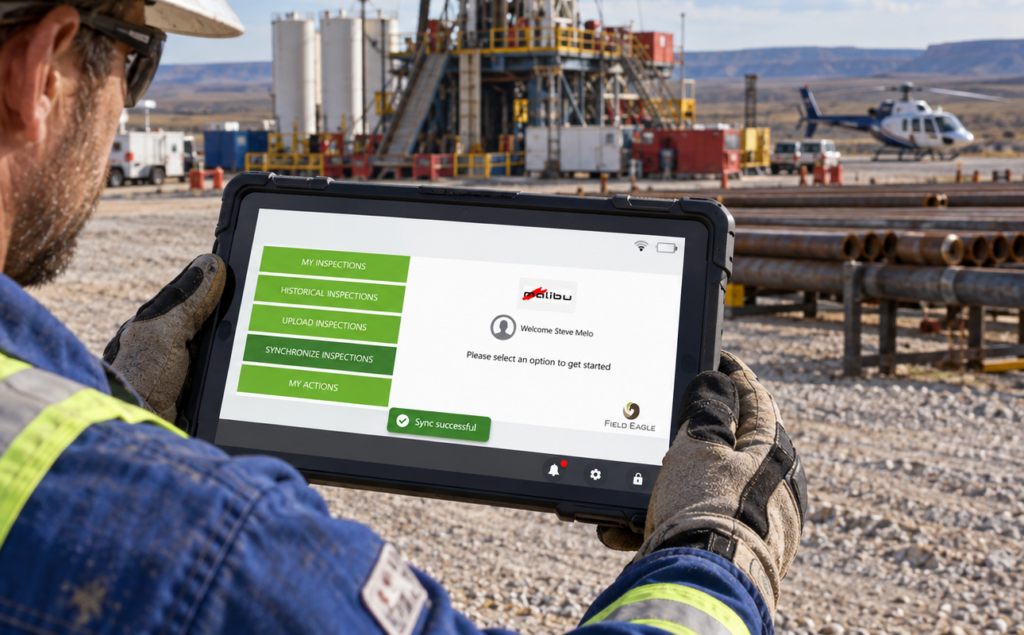
PSI configured multiple inspection templates and inspection types around individual assets. Inspectors could record different answer types, capture photos, attach documents and synchronize completed work even when connection quality was unreliable.
Training documents and videos were attached to inspection items to guide newer inspectors in the field. Submission rules highlighted incomplete items and prevented partially completed inspections from being sent. Once synchronized to head office, reports could be generated through the reporting module.
Reporting time fell from weeks to hours. Inspectors spent less time rebuilding reports and more time carrying out billable inspection work, while clients received the finished deliverable sooner.
Embedded guidance supported faster onboarding, and completion controls reduced the likelihood of a missed inspection item. Together, those changes addressed the two costs that mattered most: time between field work and payment, and the risk of returning to a remote asset to collect missing information.
Inspectors received assigned work and asset-specific templates on mobile devices. They captured answers, photographs and supporting documents in the field, used embedded guidance when needed and synchronized completed inspections to head office. Reports were generated from the synchronized record rather than recreated in a spreadsheet.
For PSI, the final report triggered payment. Reducing report preparation therefore improved more than customer turnaround: it shortened the time between performing the work and invoicing it. Completion rules also reduced the risk of an expensive helicopter-supported return visit to collect a missed item.
This workflow is suited to oilfield, marine and third-party inspection companies working in remote or hazardous locations. It is most valuable when network quality is unreliable, client reports are complex and inspection quality must remain consistent as the team adds new inspectors.
Field Eagle brings mobile data collection into one Inspection Management Software workflow. Teams can use Field Inspection Software at the point of work, maintain asset-specific histories with Asset Inspection Software, and configure the broader Inspection Software process around required forms, evidence and reports.
For organizations that need connected business systems, review available Integrations. Teams can also use structured records to support internal standards and external Compliance requirements.
Look for a mobile inspection system that can collect structured data and evidence when connectivity is unreliable, then synchronize securely when a connection becomes available. PSI selected Field Eagle partly for its robust synchronization.
A properly designed mobile workflow can continue independently of connection quality and synchronize later. Teams should confirm how conflicts, attachments and incomplete uploads are handled before deployment.
Capture the report data once during the inspection, keep photographs attached to the correct items and generate the client output from the same record. PSI replaced paper-to-spreadsheet transcription and reduced reporting from weeks to hours.
Contextual guidance can be attached to each inspection point. PSI added documents and videos so less-experienced inspectors could review the relevant instructions while completing the work, while required fields prevented incomplete submission.