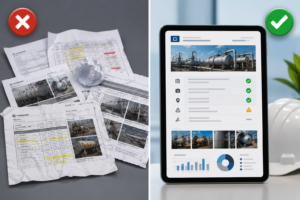
The oil and gas industry is one of the most heavily regulated industries, and safety on oil rigs is of paramount importance. One way to improve safety and efficiency in the industry is by digitizing oil rig inspections. Here are some benefits of digital oil rig inspections:
Increased Safety on Oil Rigs
Digital oil rig inspections can increase safety by identifying potential hazards and risks. By using digital technology, inspectors can quickly identify safety issues and take corrective action. This can reduce the risk of accidents and injuries, protecting workers and the environment.
Improved Efficiency
Digital oil rig inspections can improve efficiency by automating data capture and reducing manual data entry. This can save time, reduce errors, and enable inspectors to complete more inspections in less time. Additionally, with real-time data analysis, inspectors can identify areas for improvement and take corrective action quickly.
Better Data Quality
Manual data entry can be prone to errors, resulting in incomplete or inaccurate data. Digital oil rig inspections can improve data quality by automating data capture and validation. This can provide more accurate data, enabling companies to make informed decisions.
Improved Reporting
Digital oil rig inspections can improve reporting capabilities by providing real-time data analysis. With digital data capture, companies can generate reports quickly and easily, providing valuable insights into their operations. This can help companies identify trends, areas for improvement, and opportunities for growth.

Enhanced Compliance
The oil and gas industry is heavily regulated, and compliance is essential. Digital oil rig inspections can enhance compliance by providing a secure audit trail. With digital data capture, companies can store inspection data securely, providing an audit trail for compliance purposes. This can help companies meet regulatory requirements and avoid costly penalties.
Cost Savings on Oil Rigs
Digital oil rig inspections can result in cost savings. With improved efficiency and reduced manual data entry, companies can complete more inspections in less time, reducing labor costs. Additionally, with real-time data analysis, companies can identify opportunities for cost savings and operational efficiencies.
In conclusion, digital oil rig inspections can provide companies with a range of benefits, including increased safety, improved efficiency, better data quality, improved reporting, enhanced compliance, and cost savings. By leveraging digital technology, companies can streamline their operations, improve their bottom line, and gain a competitive edge in the oil and gas industry.
And if you’re ready to see how easy it can be to get all of the benefits of digitizing inspections aboard oil rigs, then contact Field Eagle for a Demo today!
FAQs
Digital inspections improve hazard detection by structuring field data capture around predefined risk categories such as pressure anomalies, corrosion indicators, gas exposure levels, and equipment integrity checkpoints. Instead of relying on narrative notes, inspectors input standardized fields that trigger validation rules. This reduces ambiguity in reporting and enables faster escalation of critical findings. In offshore environments where conditions change rapidly, this structured capture helps surface latent risks that might otherwise be overlooked during manual reviews.
Manual inspection data often suffers from transcription delays, incomplete fields, and subjective interpretation of conditions like “minor corrosion” or “acceptable wear.” In offshore contexts, environmental constraints such as wind, vibration, and limited access increase the likelihood of missed inputs. Additionally, paper-based workflows introduce lag between observation and central reporting, which weakens the operational relevance of the data by the time it reaches decision makers.
Digital systems enable immediate routing of inspection findings into predefined workflows. Once a defect is logged, it can be automatically assigned a severity score and linked to maintenance queues or safety escalation protocols. This removes the dependency on manual review cycles and reduces latency between detection and intervention. In practice, this shortens the time between identifying issues like valve degradation or structural fatigue and initiating remedial action.
Offshore compliance frameworks require traceable, auditable, and repeatable inspection records. Inconsistent inspection formats make it difficult to demonstrate adherence to standards across multiple rigs or jurisdictions. Digital systems enforce uniform data schemas, ensuring that each inspection record contains comparable metrics such as pressure readings, inspection timestamps, and equipment identifiers. This consistency is essential for audits, incident investigations, and regulatory reporting under multi-agency oversight.
Digital inspection systems convert field observations into structured datasets that can be analyzed for degradation patterns over time. When combined with historical inspection cycles, this enables early identification of failure precursors such as increasing vibration amplitude, recurring seal wear, or pressure fluctuation trends. These signals support predictive maintenance models that shift operations from reactive repairs to scheduled interventions, reducing unplanned downtime and extending asset lifespan.